The current situation in Germany’s ZEW survey fell short of predictions, recording -82 instead of -77

Germany’s ZEW Economic Sentiment index for the current situation fell below forecasts in May, recording a figure of -82 compared to the expected -77. This indicates a more challenging economic environment than anticipated.

The United States Consumer Price Index (CPI) inflation report for April is due to be published by the Bureau of Labor Statistics at 12:30 GMT. The forecast suggests that the inflation index will rise at an annual rate of 2.4%, consistent with March, while core CPI inflation is predicted to remain at 2.8% year-over-year.

Market Sentiment and Risk Assets

Markets experienced a revival as the US and China paused their trade war escalation, creating a notable shift in sentiment. The adjustment in market mood saw an increase in trading of risk assets, suggesting optimism that recent difficulties might be easing.

Foreign exchange trading on margin entails a high level of risk and may not suit everyone due to the potential for significant losses. The leverage involved can also magnify both gains and losses. It is essential to carefully assess investment goals, experience level, and risk tolerance before engaging in foreign exchange trading.

Given the slump in Germany’s ZEW Economic Sentiment for the current situation, there’s a clearer signal of deteriorating conditions within the region. A print of -82, noticeably under the forecasted -77, underscores a wider level of dissatisfaction among institutional investors and analysts when assessing current economic health. This type of reading often foreshadows a drag on near-term economic activity. It’s not just a one-off dip—it follows previous soft patches, suggesting sentiment hasn’t recovered from past shocks.

What that means for us more broadly is that European markets could carry more downside than upside catalysts until data starts showing consistent strength. Bonds and rate-sensitive assets may respond to these disappointments with more demand, particularly on the safer end of the curve. Equities, on the other hand, may find it harder to hold ground unless we see signs of improving industrial output or policy support.

US Inflation and Market Reactions

Now, turning across the Atlantic, all eyes sit squarely on the April inflation release in the United States. Expectations are for annual inflation to remain at 2.4%, while the core figure is projected to hold steady at 2.8%. Should either component overshoot, traders should be ready for volatility. It wouldn’t take much—particularly with rates sensitive to even slight changes in inflation sentiment—to spark new positioning among institutions.

If the report aligns exactly with consensus, it implies that disinflationary forces aren’t gaining traction quickly enough. For those exposed to rate speculation, especially in options and futures markets, a flat core reading keeps the Federal Reserve in a holding pattern. Any considerable undershoot, however, would be pivotal—suddenly, the discussion around rate cuts could gain tangible timing. The market would likely interpret it as a green light to accelerate bids in shorter-dated treasuries, alongside a quick repricing across interest rate derivatives.

With the temporary cool-down in tensions between the US and China, we’ve observed early signs of reinvigoration in global risk appetite. Positioning in equity-index futures and related volatility products seems to have turned a corner. It’s not just the pause in tariff threats; liquidity has responded favourably, and inflows into high-beta sectors show that traders perceive better short-term reward potential. Still, the optimism hinges heavily on the data backing it up.

Shifting toward the engine room of risk—foreign exchange—no reminder is too many when it comes to ignoring leverage dangers. We remain highly alert here. Movements in major crosses may seem subtle one day, but the use of leverage means exposures can turn rapidly and unpredictably. Losses can far exceed deposits when volatility picks up around key macro events, and we should assume more surprise prints from data releases in the near term.

Therefore, as we enter a cycle of clustered major releases—from inflation to purchasing managers’ indices—it is critical to constantly reassess directional bias. Carry trades may become more appealing in low-volatility settings, but should inflation move unexpectedly or geopolitical headlines resurface, a swift unwind would not be uncommon.

Instruments with embedded optionality or knock-out features are likely to be tested. We advise closely monitoring implied volatility pricing, especially in G10 crosses, as well as any shift in the forward curve for yield-based instruments. These can provide early insights into market recalibration when economic assumptions are challenged.

We’re watching for more than just data surprises—we’re mapping how divergences in economic momentum between major economies play out in pricing actions. Traders should prepare for well-defined ranges suddenly breaking as consensus disintegrates. Timing will matter, but so too will patience.
Create your live VT Markets account and start trading now.

China is developing large ports in South America to enhance agricultural imports and ensure food security

China is constructing megaports in South America to address its crop demands. The country assures its citizens of a stable food supply even without relying on U.S. crops.

China’s state grain trader, Cofco, plans to establish the world’s largest export terminal in Brazil. This initiative aims to replace U.S. soybeans and other foodstuffs by tapping into South American resources.

Challenges Facing Brazil’s Export Capacity

However, Brazil’s main export port to China, Santos, faces limitations regarding capacity and infrastructure. Furthermore, Brazil grapples with fertilizer supply challenges and soil nutrient depletion, affecting crop production advancement.

In diplomatic moves, China’s foreign minister recently held discussions in Beijing with Brazil’s counterpart. Additionally, China expressed its intention to purchase approximately $900 million worth of soybeans, corn, and vegetable oil from Argentina.

What we’ve seen so far points to a clear strategic shift. By financing and building mega ports in South America, and by arranging deals in both Brazil and Argentina, China is working to reduce its reliance on U.S. agricultural imports. The announcement from Cofco to invest heavily in Brazil indicates more than just trade preferences – it shows long-term positioning.

This sheds light on China’s broader tactic: reshaping its supply chain for food security reasons. Notably, Brazil has the land and the harvest volume, but the ports, especially Santos, are already under pressure. Bottlenecks caused by limited infrastructure mean expansions can’t deliver overnight shifts in global flows. The soil health concerns, specifically regarding nutrient exhaustion and fertiliser scarcity, aren’t just minor agricultural hiccups. They alter the reliability of yields. If production fails to meet projected growth in the next few seasons, it could undermine China’s expectations.

Implications for Global Commodity Markets

The involvement of high-level officials further strengthens the trade commitment, particularly with Argentina. A $900 million offer sends a focused message – Beijing is not hesitating to secure supplies in two of South America’s key producers, even if it comes with logistical or qualitative compromises. These moves also steadily shift bargaining power in global commodity markets, and with that, new patterns in price sensitivity and volume liquity start to form.

For us, this instability in the traditional supply chain doesn’t signal immediate price disruptions, but it does reframe where risks will surface. If these port investments in Brazil proceed as planned, and volumes rise as intended, basis prices across regions may separate more than usual. Meanwhile, uncertainty around Brazilian production capacity – from weather to soil inputs – leaves any smooth transition less than assured.

Given these developments, attention must be given to freight capacity from South America, reliance on river transport, and any farmer response to fertiliser pricing. With attention tilted toward Argentina as well, we anticipate two harvest windows – Brazilian and Argentinian – to carry more weight in market pricing than before. Differentials between U.S. and South American futures may widen on timing alone, let alone on quality or availability.

An increase in long hedges from Chinese buyers across South American origin will likely affect open interest positioning too. Dislocations could arise if investors underprice Brazil’s potential shipping delays or if Argentina faces political changes that block exports. Early indicators of port congestion or fertiliser shortage should be monitored closely and used to reassess spreads, particularly into Q4.

We are entering a cycle where conventional models based on U.S. exports may underperform. Assumptions on average port throughput, barge movements, or input costs in South America may no longer apply with the same confidence. It’s now less a question of transition, and more of competition.

Create your live VT Markets account and start trading now.

The Euro is expected to weaken against the US Dollar, with strong support at 1.1055

The Euro (EUR) may weaken further against the US Dollar (USD), but it is unlikely to breach the major support level at 1.1055. In the long run, while EUR is under pressure, whether the current pullback reaches 1.0945 remains uncertain.

On a 24-hour view, EUR dropped to a 1-1/2-month low at 1.1087, down by 1.42%. Despite oversold conditions, further USD weakening is possible, but breaking the major support at 1.1055 is unlikely. Resistance levels are identified at 1.1120 and 1.1150, which would indicate stabilisation.

One To Three Week Perspective

In a one-to-three-week perspective, last Friday’s shift from neutral to negative outlook anticipated EUR falling towards 1.1145. The decline exceeded expectations, reaching a low of 1.1064. Although downward momentum has grown, the current weakness is seen as part of a pullback, and reaching support at 1.0945 is uncertain. Only a break of 1.1225 suggests easing pressure.

This analysis involves risks and uncertainties, with no guarantees of flawlessness or timeliness. Market investments carry risks, including potential total loss and emotional distress, and all associated responsibilities lie with the individual. Users should carry out thorough research before making decisions.

What the current analysis demonstrates is a downward pull in the Euro’s value against the Dollar, though we’re seeing a fairly strong cluster of support forming around the 1.1055 level. Even with a sudden slump touching 1.1087, the structure beneath that point is robust enough that further rapid declines aren’t projected to slice through it without compelling catalysts. It isn’t about whether the Euro is weakening—it certainly is—but rather how far existing momentum can carry that weakness before counter-forces temper it.

We saw the Euro fall 1.42%, settling near the lowest level in around six weeks. That drop is stark, even if some technical conditions now suggest oversold territory. When viewed through a broader lens though, the probability of continued Dollar strength may reinforce local EUR softness. Yet, resistance at 1.1120 and 1.1150 appears very near the surface. Those zones are important—should price action rebound and climb there, it could indicate a brief footing is being found.

Directional Shift

Now looking ahead one to three weeks, we noticed a directional shift recently. The stance moved from neutral to bearish just before the weekend, and since then the pace of decline has been sharper than initial forecasts. Last week’s expectation was a moderate dip toward 1.1145, but 1.1064 came swiftly, suggesting bearish pressure intensified more than anticipated. Even with this momentum, this move still qualifies more as a short-term retracement than a true reversal of longer-term structure. The idea that the Euro might reach the next lower support around 1.0945 hasn’t yet formed into a high-conviction outcome.

That support below is worth keeping an eye on, but we’d hesitate before planning strategy around its inevitability. Too many assumptions, without fresh catalysts or shifts in macro data, would simply inject excessive exposure to sudden turns. Similarly, if prices manage to press above 1.1225 again, it would be the first solid sign that this current phase of weakness has passed.

From where we sit, the signals are mixed: firm downside action, yes, but not without areas where rebounding price could be met with stiff resistance. This subtle balance leaves very little room to operate overnight with high certainty. Rather, it encourages a trim, reactive posture that adjusts to each incremental change in price behaviour rather than predicting wholesale shifts.

For positioning, one must be very deliberate here. Overleveraging based on presumed directional continuation risks poor entry and frustrated exits when structures such as 1.1055 either hold tight or trap into limited range. These situations usually require trade entry based more on exhaustion cues than momentum chases. For example, until 1.1225 is reclaimed, any upside attempt is likely confined to the zones already mentioned—no further until those resolve.

We continue to monitor short flows into the lower 1.10s and note whether positioning gets uncomfortably crowded. That often hints at pent-up reversal potential that can catch short-duration trades flat-footed. At the same time, assumptions of a bottom forming too early can derail any attempts to carry trades across brief countertrends. One keeps watch of both ends.

As prices walk this narrow line between continued weakening and holding steady, there’s no benefit in over-committing before technical signals align with fundamentals. It’s the type of sequence where technical levels—like 1.1055 and 1.0945—matter more than sentiment or thematic views. It becomes a case of tactical engagements, waiting for pressure build-up or release, rather than chasing fading moves.

Create your live VT Markets account and start trading now.

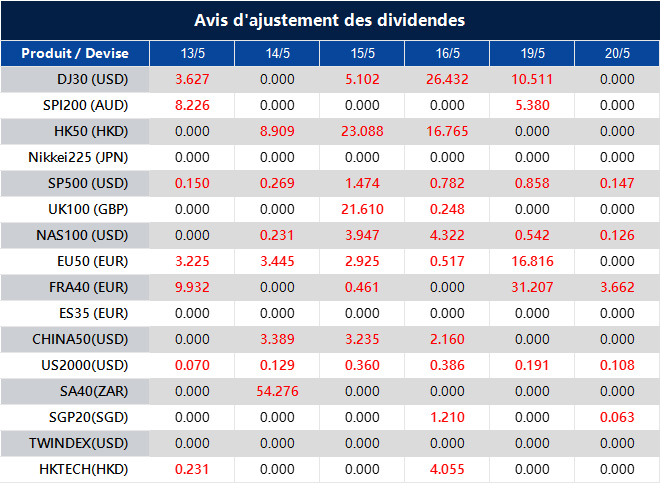
Avis d’ajustement des dividendes – May 13 ,2025

Cher Client,

Veuillez noter que les dividendes des produits suivants seront ajustés en conséquence. Les dividendes des indices seront exécutés séparément via un relevé de solde directement sur votre compte de trading, et le commentaire sera au format suivant : “Div & Nom du produit & Volume net”.

Veuillez consulter le tableau ci-dessous pour plus de détails :

Avis d'ajustement des dividendes

Les données ci-dessus sont fournies à titre de référence uniquement, veuillez consulter le logiciel MT4/MT5 pour des informations précises.

Pour toute information complémentaire, n’hésitez pas à contacter info@vtmarkets.com.

Uchida from the Bank of Japan highlights risks from US tariffs affecting Japan’s economy and prices

The Bank of Japan’s deputy governor stated that US tariffs exert pressure on Japan’s economy. Despite this, there are potential risks to Japan’s prices due to these tariffs, which could lead to both positive and negative outcomes.

Economic growth in Japan is predicted to slow to around its potential. After this period of slowdown, growth may accelerate if overseas economies resume a moderate growth path.

Output Gap Expectations

The output gap is expected to remain stable. An improvement is anticipated by the end of the Bank of Japan’s three-year forecast period through fiscal 2027.

Interest rate hikes could continue if both the economy and prices improve as projected. Though inflation expectations may stagnate temporarily, a tight job market could drive wages up.

Japan’s economy is likely to recover if the global economy grows, boosting inflation and expectations. High uncertainty surrounds these forecasts, so decisions will be made as conditions evolve.

A strong yen could negatively impact exports and major manufacturing profits. However, it could enhance household real income and improve retailer profits through reduced import costs.

Exchange Rate Volatility

Rapid fluctuations in foreign exchange can complicate business planning. Japan’s finance minister is keen to discuss foreign exchange rates with counterparts.

The article outlines remarks and projections from policy authorities concerning Japan’s current and future economic situation, especially under the pressure of US-imposed trade tariffs. Though these external shocks may weigh down production and sentiment, they also set off a chain of reactions in domestic inflation and industrial pricing. Short-term disruptions seem tolerable for now, but we should be wary — economic data from the next two quarters will matter much more than usual. The suggestion here is that currency movements and global demand might create a whiplash effect through different revenue channels and cost structures.

From a trading perspective, this opens a narrow but measurable window for directional bets. Wage growth, while still fairly weak, could stir inflation in the medium term, especially if hiring trends hit record lows again. Price momentum might sag in the near run, but we should expect stronger signals as wage bargaining trickles into consumer pricing later this year. Futures tied to Japanese government bonds and inflation-protected instruments could reflect this tightening path well in advance. Careful staggering of duration risk may be necessary.

The forecast period running to fiscal 2027, while far out, tells us that incremental steps are more likely than sharp pivots. If the output gap does start to close more steadily toward the second half of this cycle, upward pressure on short- and medium-term rates could arrive faster than many have priced in. That means even slight upward revisions in quarterly GDP or wage data will matter outsize in positioning.

On top of all this, the yen’s volatility stands out as a wild card. A stronger currency may dent overseas earnings, but there’s another layer here: lower input costs for domestic sellers could, in time, rebuild margins. We might see retail names reflecting that story before it appears in broader indices. But the window is short. Wide swings in exchange rates aren’t just annoying; they sideline investment decisions, which leads to deferred spending and changes in hedging behaviour.

Given all this, sharp moves in swaps, especially where they diverge from real economy data, may present opportunities. We should dial in closely to wage negotiations, foreign currency reserves data, and input prices, especially in manufacturing and retail. If policymakers comment more on currency intervention or trade policy alignment, that reinforces that FX intervention risk is on the table. Waiting on confirmation indicators won’t work in the short term; better to recalibrate before it becomes reactive.

Lastly, it’s worth watching how other central banks treat inflation surprises. Any shift in the yield differentials could influence carry trades around the yen, moving risk sentiment quickly. The dominoes can fall fast, and even small changes across the yield curve might present asymmetric return setups. Avoid anchoring to earlier expectations – price in flexibility, not forecasts.

Create your live VT Markets account and start trading now.

After mixed UK employment data, EUR/GBP trades around 0.8420, ending its six-day loss streak

EUR/GBP maintains stability following the release of UK employment data. The UK ILO Unemployment Rate rose to 4.5% for the three months ending in March, compared to 4.4% previously.

After a six-day decline, EUR/GBP trades around 0.8420 during early European trading on Tuesday. Markets anticipate the ZEW Economic Sentiment surveys from Germany and the Eurozone for insights into institutional investor confidence.

UK Employment Data

The Office for National Statistics reported a Claimant Count Change increase of 5,200 in April, contrasting with a revised decrease of 16,900 in March. Employment Change figures show a rise of 112,000 in March, down from February’s 206,000.

Mixed wage growth data shows Average Earnings, excluding bonuses, increased by 5.6% year-over-year, below both the previous 5.9% and the expected 5.7%. Including bonuses, wages increased by 5.5%, exceeding forecasts of 5.2%.

According to reports, European Central Bank officials suggest the policy review will likely confirm existing strategies such as QE. The ECB’s commitment to “forceful action” during periods of low rates and inflation remains emphasised.

From what we’ve seen this week, the EUR/GBP has been relatively muted, brushing off the fresh labour market figures out of the UK. Stability around the 0.8420 mark, despite a modest uptick in the unemployment rate to 4.5%, suggests traders aren’t yet shifting their broader bias. That figure, while incremental, points to a slightly cooling market—nothing alarming, but worth acknowledging when shaping exposure in rates or FX-linked derivatives.

Market Reactions and Analysis

The Claimant Count ticked higher by 5,200 in April—small, yes, but in sharp contrast to the revised 16,900 drop in March. A reversed dynamic like that can jar sentiment at the margin, particularly when the Bank of England has already been leaning toward a cautious tone. Interestingly though, job creation remained positive, if decelerating. The increase of 112,000 in employment isn’t negligible, yet when compared to February’s 206,000, there’s a clear moderation in pace. We interpret this as a gentle softening, which could dampen the need for further near-term tightening while reinforcing medium-term dovish recalibration.

Wage growth metrics offer a more nuanced picture. Excluding bonuses, earnings rose 5.6% annually—under both forecast and the prior print. Including bonuses, however, we note an upside surprise: an annual increase of 5.5% versus the 5.2% consensus. That uneven pressure in pay signals a possible stickiness in services inflation, despite fading recruitment momentum. It opens the door for diverging scenarios in policy responses and urges caution when defining volatility ranges or strike selection, particularly for front-month options plays.

On the continent, the focus turns to sentiment from institutional participants via the ZEW surveys. These forward-looking gauges, covering both Germany and the broader bloc, are often picked apart for early signs of business cycle shifts. They can inform momentum trades, not merely directional plays but spread-based strategies as well. Especially with the ECB leaning on consistent messaging—continuing QE where appropriate, favouring forceful intervention if inflationary tailwinds fade—we see scope for broader consistency in their communications, effectively anchoring long-end expectations.

Lagarde and her counterparts have made it clear: they won’t flinch if easing is required. Unlike more erratic central banks, their direction points more towards controlled adjustments, not volatility reaction. That lends itself well to calendar spreads across eurozone yields and relative value setups across front-end swaps, particularly as implied vols remain well-anchored across maturities.

We believe this steadiness across both currency and policy expectations allows for short-term short gamma positioning, assuming range-bound trading holds. However, as labour signals in the UK begin to diverge from wage trends, there’s scope for sharp re-pricing if wage inflation remains embedded. That would ripple into BoE rate expectations, injecting sudden two-way risk.

Reaction among institutional players to this week’s ZEW data and any ECB commentary could provide the next catalyst. For now, two economies show signs of divergence—one softening in employment while the other relies on guidance for bond market anchoring. Trade construction should adjust in kind.

Create your live VT Markets account and start trading now.

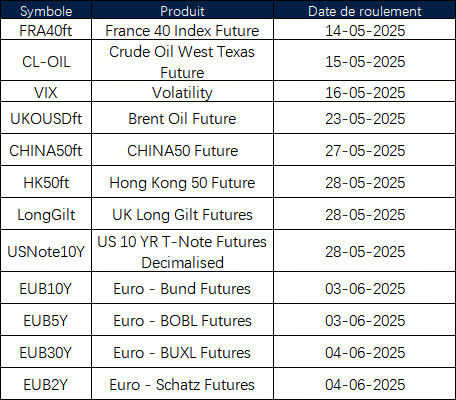
Annonce de roulement des contrats à terme en mai – May 13 ,2025

Cher client,

Les nouveaux contrats seront automatiquement reconduits comme suit :

Annonce de roulement des contrats à terme en mai

Veuillez noter:
• Le rollover sera automatique et toutes les positions ouvertes existantes resteront ouvertes.
• Les positions ouvertes à la date d’expiration seront ajustées via des frais de roulement ou un crédit pour refléter la différence de prix entre les contrats expirants et les nouveaux.
• Pour éviter les rollovers de CFD, les clients peuvent choisir de fermer toutes les positions CFD ouvertes avant la date d’expiration.
• Veuillez vous assurer que tous les paramètres de take-profit et de stop-loss sont ajustés avant que le rollover ne se produise.
• Tous les transferts internes vers des comptes portant le même nom seront interdits pendant les premières et dernières 30 minutes des heures de trading aux dates de rollover.

Si vous souhaitez plus d’informations, n’hésitez pas à contacter info@vtmarkets.com.

In Australia, April’s business confidence fell slightly, while conditions remained just below average levels

The National Australia Bank business survey for April 2025 shows a shift in business confidence from -4 to -1. Business conditions decreased slightly, moving from +3 to +2, which is notably below the long-term average.

Within the measured subcategories, the sales index remained stable at +5, and employment also held steady at +4. However, profitability saw a decline, dropping 4 points to -4, attributed to increased purchase costs affecting margins. The capital spending index experienced a 6-point decrease to +1, reflecting hesitation in new investments amid uncertainty over US trade policy.

Interest Rate Expectations

The Reserve Bank of Australia is expected to cut interest rates in its upcoming meeting on May 20. This potential rate cut may bolster sentiment in the business community.

Taken together, these numbers give us a snapshot of a private sector that is hesitating rather than retreating entirely. Confidence had been deeply negative, so the slight lift from -4 to -1 might seem minor at first glance, but traders should not overlook the timing—it comes just ahead of a likely rate move. Conditions, while still in positive territory, have lost some momentum, slipping to +2 and dipping under the historical norm, which raises questions about how sustainable current activity levels truly are.

Sales and employment holding firm suggests that day-to-day operations continue with some resilience. When revenue and staffing remain steady, it usually means short-term demand hasn’t deteriorated. However, it’s the profitability reading that draws the most attention. A fall into negative territory, especially driven by rising purchase costs, tells us that firms are facing growing margin pressure. They’re selling, they’re hiring, but they’re making less money doing it. That squeeze can’t go on too long without other parts of the business being affected.

What’s more, the sharp drop in capital expenditure—from a reasonably solid +7 down to +1—gives a clear message: companies are pulling back on future-facing commitments. That doesn’t come from nowhere. The report connects this cool-off in capex to trade policy uncertainty in the United States. When firms are unsure about external demand or the stability of international supply flows, they often park investment decisions. That now appears to be happening.

Market Sentiment and Derivatives

For those of us watching this from a derivatives angle, the likely RBA rate cut on May 20 has already started to shape sentiment. While the market has priced in the move to an extent, the impact on options pricing, especially near-term volatility on rates and currency products, could widen more rapidly if the central bank takes a cautious tone when delivering its guidance. The slight bump in business confidence appears to reflect an expectation that monetary easing will continue, but if that support fails to materially lift conditions or restore profitability margins, the next round of macro releases could act as stronger market catalysts.

One way to interpret the numbers is this: the domestic economy isn’t contracting, but it’s waiting. Waiting for clarity on global headwinds, waiting for cheaper borrowing costs to flow through—waiting, in short, for the next reason to act decisively. From our perspective, this kind of stall pattern can leave pricing susceptible to sudden revaluations, especially in short tenor instruments.

Track spreads between employment and profitability indices. When hiring remains constant but margins narrow significantly, something usually gives. Keep close to implied volatilities around that May 20 date—should forward-looking indicators start to hint at further margin contraction, implied rates could dislocate from currently assumed forward paths.

We are now in a situation where firms are doing just enough to maintain stability, with early signs that any external pressure could push them into retraction. Pay particular attention to sectors sensitive to overseas inputs or US-exposed export flows—additional news on tariffs or trade route shifts could bring abrupt shifts in equity-linked derivatives or sector-specific hedging behaviours.

Branch out from central bank forecasts. This report shows us that even with rate cuts, the problem may lie more in confidence and profits than in borrowing costs. That’s a shift worth modelling.

Create your live VT Markets account and start trading now.

At the European opening, WTI crude oil trades bearish at $61.53 per barrel, down slightly

West Texas Intermediate (WTI) Oil prices decreased early in the European session on Tuesday, with WTI trading at $61.53 per barrel down from Monday’s $61.60. Brent crude also saw a small decline, trading at $64.66 after a previous close of $64.71.

WTI Oil, a high-quality crude type, is sold internationally and considered easy to refine due to its low gravity and sulphur content. It is sourced in the United States and distributed from the Cushing hub, a major conduit for oil transportation. The price of WTI Oil is influenced by supply and demand dynamics, global growth trends, political instability, and OPEC’s production decisions.

Weekly Oil Inventory Data Importance

Weekly oil inventory data from the American Petroleum Institute (API) and the Energy Information Agency (EIA) are crucial. Changes in inventories can indicate shifts in supply or demand: an inventory drop often signals increased demand, while higher inventories suggest increased supply. OPEC decisions on production quotas greatly impact prices, as lowering quotas tends to raise prices by tightening supply. Meanwhile, production increases can drive prices down.

This pullback in WTI and Brent reflects more than a minor adjustment. While price movements of just a few cents may seem uneventful on the surface, the underlying balance of supply assumptions and sentiment reveals broader hesitation. WTI’s mild retreat to $61.53 opens a narrow window of opportunity. It comes against the backdrop of sensitive supply mechanisms and subtle shifts in demand expectations, particularly from refiners stepping down activity in Asia and parts of the southern US amid upcoming seasonal maintenance.

The key for us—particularly those positioning in shorter-dated contracts—is how inventory figures unfold in the days ahead. Last week showed a surprise build in crude stocks, not wildly out of range, but enough to sap momentum from the bulls and trigger modest exits. If the API or EIA data this time mirror that tone—especially if simultaneous signs point to sluggish drawdowns in distillates—we may see continued downward pressure, at least through the front-month contracts.

We also need to be mindful of the ripple effects of OPEC+ behaviour. Their language around production targets has recently become more cautious, even non-committal at times. Riyadh and its core group within the organisation appear to be loosely aligned on holding output steady through the early summer period. But any deviation—particularly if one of the secondary producers, say Angola or Iraq, veers from voluntary limits—could produce uneven reaction across futures.

Impact of OPEC Decisions and Market Structure

It’s equally important to watch physical demand signals outside of the inventory datasets. Spreads between regional benchmarks—say, the WTI-Brent differential—are narrowing, suggesting decreasing transport flows and marginal arb trades drying up. For those managing calendar spreads or holding straddles, it means a potentially flatter structure in the near term. The classic contango or steep backwardation that’s often rewarded with directional bets may soften unless there’s a clear macro driver or geopolitical pulse shift.

Derivative volumes in fuel-linked contracts have thinned modestly week-on-week. The lower liquidity weighs on order books and can exaggerate intraday price moves with less capital. This can create intraday mispricings—opportunities, perhaps, for those willing to engage with tighter stops and rigorous execution discipline. But we aren’t in a runaway market—underlying volatility measures remain underwhelming, and implied vol in December and March expiry contracts has barely moved.

For now, strategy leans defensive. There’s little incentive to extend leverage until we see firmer justification from physical data or a breakdown in OPEC messaging. Risk skew is gently favouring puts over calls, echoing fatigue among long-biased flows. So any coverage of upside should be tight and short-dated. Long gamma positions remain unfavourable at current vols unless we expect surprise policy moves or sharp supply interruptions—not something we see in the immediate term from Gulf producers.

As ever, the Cushing delivery point bears watching more closely when WTI prices hover near stable support levels. An increase in stockpiles there over the incoming week would signal waning throughput demand. That, in turn, reinforces what we’re seeing in the futures curve—bearish flattening, fewer rolling incentives.

We’re not in a broken market, far from it. But for directional conviction to gather pace again—either way—it will require credible shifts in spot inventories or a meaningful political curveball. Until then, hold balance. Trade what’s in front of you, not what’s expected next month.

Create your live VT Markets account and start trading now.

The central rate for USD/CNY was set at 7.1991, stronger than previous rates and estimates

The People’s Bank of China (PBOC), the country’s central bank, is charged with determining the daily midpoint of the yuan, also known as the renminbi (RMB). The PBOC employs a managed floating exchange rate system that allows the yuan’s value to move within a predefined “band” surrounding a central reference rate, or “midpoint.” This band is currently set at +/- 2%.

Today’s yuan midpoint is the strongest since 7 April and is the first setting below 7.2 since that date. The previous close was at 7.2075.

Central Bank Liquidity Action

The PBOC injected 180 billion yuan using 7-day reverse repurchase agreements at an interest rate of 1.40%. On the same day, 405 billion yuan matured, resulting in a net liquidity withdrawal of 225 billion yuan.

What the existing content lays out is a clear signal about how the central bank is balancing its short-term liquidity tools with its longer-term goals on currency control. The midpoint setting—lower than 7.2 for the first time in over a month—suggests a slightly more confident stance towards stabilising or even strengthening the currency. When we observe such a move, it typically hints that policy officials are less concerned about depreciation pressures, or that they are willing to let the renminbi show a bit more resilience—at least temporarily.

At the same time, the liquidity operation tells a slightly different story. Injecting 180 billion yuan through 7-day repos at 1.40% would normally be read as a supportive move—and would usually indicate that the authorities are keen to manage short-term liquidity expectations tightly. However, with 405 billion yuan maturing on the same day, the net liquidity effect is actually negative by 225 billion yuan. That represents a deliberate tightening. Liquidity has not been drained by accident. It reflects a deliberate desire to cool excess cash in the short-term funding system, most likely to lean against speculative flows or simply to keep interbank rates from falling too far.

For us, that matters. What’s being communicated—without being said explicitly—is that price stability remains a priority, and that any attempts to gauge policy easing from the currency fix alone should be tempered. When you take both moves together—the slightly firmer currency stance and the liquidity reduction—they form an unusually clear policy signal. Not aggressive tightening. Certainly not aggressive easing. It’s more akin to gently tapping the brakes when the car is approaching a downward slope.

Implications For Hedging Decisions

From where we sit, this compels a more fine-tuned approach to option positioning and near-term hedging decisions. Pairs involving the yuan should see a flatter implied volatility curve, particularly in the front-end. There’s not enough of a shift here to justify aggressive long-vol positions, especially not in the 1-week or 2-week tenors. Any pricing that still reflects heightened expectations of currency drift should be treated with due scepticism.

When short-end liquidity is moving in this way—swapping maturity windows for a withdrawal—it informs us that carry trades priced with low overnight costs could suddenly run into headwinds. Traders banking on seamless roll-overs may want to reduce leverage. We aren’t in a disorderly environment, but we are in one that could foster unexpected liquidity premiums across even relatively stable naming conventions.

The central bank isn’t shouting; it’s tweaking. Nobody is signalling a major reversal. But if we think in these terms—subtle reinforcement rather than blunt messaging—it becomes easier to see where short-term pricing could compress. There’s room to extract edge, but only by staying light. Not being overcommitted is particularly important when policy shifts are happening through technicals rather than grand pronouncements.

There is also a wider implication on longer-term vol structures that often gets overlooked. If policymakers are this willing to let the midpoint flex without letting overnight liquidity go unchecked, then we might soon start to see calendar spreads adjust modestly—especially in pairs where policy divergence is less stark. These aren’t huge trades, but they are there, and the market isn’t necessarily priced for them.

For those of us watching volatility curves, we may want to adjust our assumptions on gamma spikes around fixings or known liquidity windows. The non-obvious takeaway here is that calmer midpoint fixings do not imply looser money. They can, in fact, suggest the opposite. Liquidity is still the driver. And in this case, it has quietly moved in a direction that trims risk appetite without undermining policy credibility. That’s the pattern worth watching.

Create your live VT Markets account and start trading now.

Back To Top
server

Bonjour 👋

Comment puis-je vous aider ?

Discutez immédiatement avec notre équipe

Chat en direct

Démarrez une conversation en direct via...

  • Telegram
    hold En attente
  • Bientôt disponible...

Bonjour 👋

Comment puis-je vous aider ?

Telegram

Scannez le code QR avec votre smartphone pour démarrer un chat avec nous, ou cliquez ici.

Vous n’avez pas l’application ou la version de bureau de Telegram installée ? Utilisez plutôt Telegram Web .

QR code