ONE Gas experienced a 23.3% revenue increase and EPS rose to $1.98 compared to last year

For the first quarter of 2025, ONE Gas reported a revenue of $935.19 million, marking a 23.3% increase from the previous year. The earnings per share (EPS) were at $1.98, rising from $1.75 in the prior year.

These figures exceeded the Zacks Consensus Estimate, with revenue showing a 16.38% surprise over the estimated $803.58 million and EPS surpassing the anticipated $1.85 by 7.03%. The performance reveals key metrics including the volumes and revenues of natural gas sales and transportation.

Natural gas transportation volumes reached 65,300 MMcf, above the 64,475.83 MMcf estimate. Total sales volumes delivered were 79,300 MMcf, exceeding estimates by over 7,000 MMcf.

Residential sales volumes hit 58,900 MMcf, again surpassing the estimate of 56,064.04 MMcf. Commercial and industrial sales volumes were 19,200 MMcf, also above the expected 17,254.44 MMcf.

Natural gas sales generated $870.40 million in revenue, surpassing the estimated $719.29 million. The average number of customers was 2,305, slightly below the 2,306 estimate, with transportation revenue reaching $43.80 million against the $41.35 million expectation.

The reported first-quarter figures from ONE Gas show a sharp outperformance, with both revenue and profit per share climbing much higher than analysts had forecast. Revenue grew by over 23% compared to the same period last year, and earnings per share were up to $1.98, from $1.75. That’s a striking push beyond consensus estimates – nearly 16.4% above the expected revenue, while earnings beat expectations by just over 7%.

These results are underpinned by strong operational metrics that couldn’t easily be attributed to coincidence. Sales volumes in all major customer groups – residential, commercial, and industrial – were not just healthy but comfortably ahead of expectations. Residential deliveries were especially strong, coming in nearly 5.1% higher than forecast. Sales to businesses and industry also cleared estimates by a notable margin. Transport volumes and revenue both moved above projections too, even if slightly.

This kind of broad-based strength suggests demand conditions for natural gas were more favourable than models predicted. Whether that came from colder-than-expected weather, shifts in regional consumption, or temporary supply patterns, the overall effect points to robust utility performance, particularly when you consider firm-wide revenue exceeded projections by about $130 million.

Transport volumes did not just beat expectations by a slight edge but climbed meaningfully. That likely reflects stronger third-party demand across the utility’s network, which contributes margin differently from sales. While customer count remained flat – essentially matching what analysts pencilled in – the revenue per customer jumped, which could reflect better pricing mechanics or volume efficiency.

From our perspective, these results increase short-term visibility into margin stability, an important component when looking at the related derivative instruments. Option pricing is sensitive not only to volatility but also to shifts in implied forward earnings. After this kind of posting, we expect implied volatility to moderate briefly, but positioning could start leaning bullish unless external macro signals intervene.

Traders pricing risk over the next few weeks should keep in mind that high volumes and revenue outperformance like this can alter near-term expectations even if internal guidance remains unchanged. The reaction in market instruments often precedes any published revision from the company’s side, especially if investor optimism begins to price in continued volume strength through the next quarter. The absence of a gain in customer count also means growth came not from expansion but from deeper customer usage and pricing, which could impact mean-reversion assumptions in mean-variance models.

If one considers contract setups, particularly in near-the-money calls and bull spreads, the tradeoffs in premiums may realign quickly given how the surprise this quarter might re-centre the baseline. With transportation revenue also surpassing benchmarks, any derivative exposure linked to midstream exposure may now carry slightly reduced directional risk, assuming weather and regulatory assumptions remain unaltered.

You’ll likely see swings in open interest on the back of this posting, especially in shorter expiration windows around earnings drift. With spread trades still relatively affordable due to compressed implied moves leading into the report, some snapping back might follow. Keep a close eye on whether volume or customer efficiency is cited by executives in upcoming commentary, as that will directly impact volatility skew and spread width models.

After a rally, the Taiwan dollar declined as market officials urged caution and speculation restraint

The Taiwan dollar weakened against the U.S. dollar after a two-day rally, with Central Bank Governor Yang Chin-Long addressing the volatility. Yang advised market commentators to exercise caution and warned manufacturers about misleading exchange rate analyses.

DBS strategist Philip Wee noted the currency’s pullback aligns with official actions to curb speculation. This included the central bank intervening to oppose aggressive expectations for the Taiwan dollar’s rise. This intervention marked an effort to stabilise the currency market.

Recent Currency Movements

A recent update indicated there had not been a significant retracement for the Taiwan dollar. The update included daily currency movements from 6 May 2025.

Furthermore, ForexLive.com announced its transformation into investingLive.com later this year. This platform aims to provide intelligent market updates and smarter decision-making resources for market participants.

The recent moderation in the Taiwan dollar’s advance reflects more than just a pause in bullish sentiment—it highlights a broader effort by authorities to rein in narrow bets that leaned heavily on momentum rather than macroeconomic footing. It’s no coincidence that after two days of strength, the currency met resistance. There’s now a firmer sense that the central bank is drawing a line, and it’s not particularly faint.

When Yang commented on unwarranted optimism and overconfident interpretations of exchange rate shifts, he did more than just issue a routine warning. He reaffirmed the stance that the monetary authority will not entertain trends detached from core fundamentals. His words were pointed not only at analysts but also at businesses whose forecasts could tempt excessive positioning in the short term. The message came through plain: speculation will not drive policy.

Wee’s observation suggests alignment between policy and market behaviour. His assessment rightly ties the brief countertrend move to direct steps from policymakers, most likely through discreet but deliberate actions to push back on the one-sided view that the Taiwan dollar must keep climbing. In other instances, this has come in the form of rate adjustments or liquidity controls, but in this case, it’s intervention with clear policy undertones.

Future Currency Strategies

What matters now is how we anticipate future manoeuvres around this currency zone without falling into directional bias. Since daily fluctuations from May point to stalled upside pressure without much repercussion on local yields, that tells us something. It reflects a responsive—rather than pre-set—trading stance, where each reversal carries weight not from momentum, but intervention signalling.

At the same time, the rebranding of ForexLive into investingLive.com reflects how sources of information are evolving. The intended shift towards deeper insights and decision-support tools could shake up how traders absorb and apply market data. It reinforces the idea that surface-level changes—like moves of just a few basis points over a couple of sessions—are less useful unless properly framed within institutional responses and wider demand patterns.

As we continue to assess these moves, it becomes harder to support daily bullish impulsiveness on this currency, especially while the official tone remains restrictive. There’s an underlying message here that stability overrides pricing velocity. The sensible route now, at least from where we stand, may not involve chasing daily shifts but watching carefully for policy bent through pricing anomalies. Active price suppression should not be misread as weakness; rather, it signals a considered determination to dull erratic exposure.

At this point, strategies borrowed from periods of peaking demand or extreme dollar softness will likely fare poorly. Vol ranges are adjusting, and that reduces the kind of quick-turn setups many of us have relied on in recent bilateral currency trades. False breakouts, if they come, will be deliberate traps if interpreted without context.

So, we prefer reading into policymakers’ tone first, not the candles on the screen. It’s more helpful now to assess flow under neutral conditions than to anticipate another strong bias forming without clear anchor points. What we do next rests heavily on recognising what is being managed behind the scenes, especially when pricing resists broader trends.

Create your live VT Markets account and start trading now.

In April, the actual HCOB Services PMI for Spain was 53.4, under the expected 53.9

Spain’s HCOB Services PMI for April recorded a figure of 53.4, falling short of the expected 53.9. This performance indicates a slower-than-anticipated growth in the services sector.

In currency markets, EUR/USD experienced upward movement, rising above 1.1300 due to decreased demand for the US Dollar. Meanwhile, GBP/USD increased to over 1.3300 as the market reacted to trade uncertainties and an upcoming Federal Reserve meeting.

Economic Concerns And Gold Prices

Gold prices maintained a positive trend, reaching near a two-week high amid ongoing concerns about US trade policies under President Trump. These concerns have created unease about potential global economic impacts.

In the cryptocurrency sector, while the market overall remains stable, certain Artificial Intelligence tokens, such as Bittensor, Akash Network, and Saros, continued to show steadiness. Bitcoin stayed above $94,000, despite the broader market consolidation.

Recent discussions suggest that while tariff rates may have reached their peak, unpredictability in policies persists. This uncertainty underscores ongoing challenges for markets, even if headline tariffs remain unchanged.

What the existing summary indicates is a mixed and slightly anxious pulse across major markets. The underwhelming Services PMI figure from Spain, falling short of forecasts at 53.4, signals a mild softening in activity. Notably, within Europe’s broader economic gears, slower service growth hints at reduced upward pressure on inflation over the next quarter. And for those of us dissecting rate expectations, particularly in the eurozone, this kind of reading makes sustained hawkish posturing from the ECB a bit less convincing.

Shifting to the currency side, euro strength against the dollar—climbing back above 1.1300—reflects not just euro resilience, but a wider retreat from the greenback. Worth noting is that this movement has far less to do with European fundamentals and far more with softening demand for USD. Powell’s remarks, and more broadly, the uncertain stance heading into the Fed’s next policy meeting, are dampening investor appetite for further dollar exposure. Sterling’s climb, too, beyond 1.3300, anchors itself in the same indecision, with added nervousness around long-term trade frameworks, particularly between the UK and major partners.

Market Sentiments And Future Outlook

Looking more broadly, gold’s steady upward drift—hovering around a two-week high—is a clear tell: capital is seeking caution. It’s not just hedging against economic turbulence, it’s also expressing doubt over Washington’s clarity on long-term policy commitments. Concerns fed by abrupt proposals or politically-motivated tariffs are not just theoretical worries; they increase downside risk across multiple asset classes.

In crypto markets, the tone is steadier. Bitcoin holding above $94,000 shows resistance to retracement, despite a lack of explosive momentum elsewhere on the board. Smaller altcoins tied to machine learning niches—tokens we’ve watched closely like Bittensor and Akash—aren’t running, but neither are they tumbling. Investors remain engaged, if more cautious, and we can see that AI-related exposure still holds attention, likely because of interest beyond just the speculative layer.

Now, where things require immediate attention is tariff talk. We’ve heard from economists that headline rates might have topped out, but direction from Washington lacks consistency. That kind of unpredictable output, even absent new rate changes, introduces noise. Markets dislike noise. For traders, it’s these moves—ones silently affecting risk appetite—that ripple uniquely through options and volatility pricing.

In the weeks ahead, we should focus not only on central bank signals or macroeconomic data, but also on forward guidance consistency, particularly from policy decision-makers. As algorithms react quicker than ever to subtle wording shifts, our planning horizon needs to reflect both timing lags and unexpected turns. Vol positions must remain tight, gamma exposure needs to stay nimble around big events, and any sharp increase in correlation across majors or asset classes should be treated as signal rather than coincidence.

Create your live VT Markets account and start trading now.

Trump is scheduled to meet Prime Minister Carney; Lutnick discussed complexities of a potential trade deal

Trump and Canadian Prime Minister Carney are set to meet at 11.45 am US Eastern time on Tuesday. This meeting could impact trade relations between the US and Canada.

Lutnick provided an earlier preview regarding the potential trade deal with Canada. He noted that while a deal is possible, it involves complex issues.

Tuesday Morning Meeting

The meeting scheduled for Tuesday morning in Washington, between Trump and Carney, comes at a time when trade discussions carry meaningful consequences. It’s set against a backdrop of uncertainty around tariffs and bilateral agreements, particularly around resource exports and rules of origin. Traders have been watching closely for hints of steel and lumber policy implications, given prior friction in those areas. In the hours following the announcement, futures markets showed only muted movements, a reflection of hesitation rather than consensus.

Lutnick, in comments delivered earlier this week, talked through some of the challenges facing negotiators. He highlighted detailed regulatory matters still unresolved. These include content thresholds in manufactured goods, tariff schedules, and dispute resolution channels—none easily addressed without concessions. From his perspective, any arrangement to come out of the talks would likely need to pass through a longer bureaucratic process, not just a handshake.

Looking back at similar talks historically, we’ve often seen currency volatility increase in the two days prior and following this kind of summit. The risk here doesn’t lie in bold declarations, but rather in the detail—or absence—of the final joint statement. We generally anticipate short-dated option premiums to stay inflated into next week, particularly in USD/CAD. Skew bias has already moved slightly in favour of Canadian dollar strength, suggesting at least some expectation of a more cooperative tone.

Monitoring Market Reactions

We’d also be mindful of directional risk in interest rate swaps tied to North American economic activity. Cross-border capital flow expectations could adjust quickly, especially if production quotas get included in any framework. Some traders have already added optionality to hedge sharp moves, especially around energy-linked equities and transport.

From a positioning standpoint, it might be worth weighing calendar spreads over outright directional bets for now. Watching where the volume builds in post-announcement trading could offer better guidance than pre-emptive rebalancing. Timing is key—snap reactions often reverse once market dialogue turns to text interpretation and implementation estimates.

As we head toward the Tuesday meeting, attention shifts to trade-sensitive sectors and any forward-looking language in prepared remarks. Equities tied to export-driven industries could see the most shifts. How the fixed income space reacts will depend largely on references to cross-border regulatory harmonisation, or lack thereof.

At this stage, caution isn’t the same as inaction. The numbers are holding stable, but the potential for re-rating is there.

Create your live VT Markets account and start trading now.

At the European session’s onset, the Euro strengthens against the Indian Rupee, currently 95.65

The Indian Rupee rises at the start of Tuesday trading. EUR/INR shows an increase, trading at 95.65 from 95.38. Similarly, GBP/INR rises to 112.32 from its previous 112.00.

India’s economy has grown at an average rate of 6.13% from 2006 to 2023. This growth attracts foreign investment, increasing demand for the Rupee. Fluctuations in Dollar demand by Indian importers also impact the Rupee’s value.

Oil prices affect the Rupee since India imports most of its oil. Rising oil prices increase the demand for USD, leading Indian importers to sell more Rupees, potentially depreciating its value.

Inflation impacts the Rupee in multiple ways. High inflation suggests more money in circulation, lowering Rupee value. If inflation surpasses the 4% target, the Reserve Bank may raise interest rates, strengthening the Rupee and attracting foreign investment.

India’s trade deficit means it imports more than it exports, leading to periods of high US Dollar demand. Seasonal demands, order volume increases, or market volatility can drive this demand up, weakening the Rupee as it is exchanged for Dollars.

This morning’s uptick in the Rupee marks a continuation of the recent firming trend, as both EUR/INR and GBP/INR exhibit mild appreciation. Specifically, EUR/INR nudged upwards from 95.38 to 95.65, while GBP/INR moved from 112.00 to 112.32. These movements reflect persistent investor interest in Indian assets amid steady economic performance.

To unpack this rightly, we need to view the appreciation in a wider context. Between 2006 and 2023, India’s economy expanded on average by just over 6% per year. That level of long-term consistency has historically appealed to foreign investors, making Indian financial instruments more attractive. When capital flows into the country increase, INR demand rises too. As a result, the Rupee appreciates—as seen in today’s early performance.

A deeper influence, though more variable, is the demand for the Dollar within India, particularly from importers. Local firms purchasing goods, machinery, or services from abroad must exchange Rupees for Dollars. This creates waves of demand for the USD at times, and when these waves swell, like during periods of bulk imports or seasonal contracts, the INR tends to lose ground.

We also need to keep our eye closely on oil. Even modest changes in crude prices feed directly into foreign exchange movements. Since India is heavily reliant on oil imports, a global increase in price forces Indian importers to purchase more USD to cover costs, effectively applying downward pressure on the Rupee in the process. If oil prices remain elevated, we can reasonably expect the Rupee to face resistance.

Turning to inflation—its role is double-edged. Internal inflation above the 4% comfort zone tends to erode real value, which logically reduces faith in the domestic currency. However, inflation can push the Reserve Bank to act. When rates are increased to contain rising prices, India becomes attractive to yield-seeking foreign capital. This inflow pulls the offshore community into INR-denominated investments, thereby supporting the Rupee.

India does operate at a trade deficit, so at all times there is an ongoing requirement for Dollars. This is not new territory, but it does mean that the pressure on the Rupee is never far away. Short bursts of outbound payments—whether linked to commodity purchases, increased shipping activity, or portfolio adjustments—can prompt sudden reversals in the Rupee’s path.

In light of these firm causal relationships, the next fortnight is likely to be shaped by what comes out in real numbers. Watch inflation prints. Keep an eye on international oil benchmarks. Understand how RBI commentary hints at rate trajectory. If import schedules normalise and external prices soften, we can expect INR to hold or rise. But any resurgence in energy prices or a pickup in import demand could push the currency onto the back foot.

From a strategy perspective, the key lies in reading demand signals and pricing them into positions early. Short-term volatility offers opportunity, but only when rates, trade data, and commodity inputs are all read against each other. Clerical adherence to macro data, particularly inflation and energy, will be vital in decoding near-term direction. Responses here should be tailored, measured, and informed by real flows, rather than headline surprise.

The PBOC established a USD/CNY reference rate of 7.2008, below the estimated 7.2518

The People’s Bank of China (PBOC) manages the daily midpoint of the yuan, also known as the renminbi or RMB. The PBOC employs a managed floating exchange rate system, allowing the yuan to vary within a specific range around a set reference rate. This fluctuation band is currently set at +/- 2%.

Recently, the PBOC injected 405 billion yuan through 7-day reverse repos at a rate of 1.5% as part of their Open Market Operations. However, with 1,087 billion yuan maturing, this activity resulted in a net drain of 682 billion yuan. This situation follows the impact of the holiday period on market operations.

Central Bank Liquidity Management

What we’re looking at is a move by the central bank to fine-tune liquidity rather than to inject it in volume. By offering short-term funds through reverse repos while letting a larger chunk mature, the monetary authority has, in effect, tightened access to cash. This isn’t accidental. It’s calculated. Especially after the holiday lull, where liquidity typically builds up due to lighter trading activity, the bank evidently felt it appropriate to pare some of it back. The sheer scale of the maturing funds—over a trillion yuan—indicates that the withdrawal was deliberate.

Zhou, for instance, has previously hinted that too much excess in interbank cash might fuel unwanted speculative activity, which no one wants right now. By draining liquidity, albeit indirectly, pressure is applied to short-term lending rates. These inching higher could gently nudge leveraged bets towards unwinding if returns no longer justify risks.

From our point of view, this timing points to a broader intent: to maintain balance without shaking confidence. There’s been no dramatic policy shift—just a gentle steering of the rudder. This tends to cool certain trading enthusiasm, particularly in rates-sensitive segments. So, take note if you’re dealing in leveraged instruments tied to overnight borrowing costs or repo-linked derivatives — this environment doesn’t favour aggressive plays based on plentiful cash.

At the same time, the tighter conditions haven’t triggered volatility spikes in the renminbi, which suggests that expectations of wider movement around the midpoint remain generally anchored. Traders like Liu, who focus on currency-volatility strategies, have hinted at suppressed implied vols recently, and with spreads still narrow, that tells us the positioning is staying cautious. There’s little room here for breakout forecasting. The midpoint fixings provide a reliable flag in the ground — subtle in change, but consistent in signalling.

Financial Market Stability

The official +/-2% range remains untouched, but the regularity of stronger fixings than market consensus implies repeated influence. This is not random. It suppresses one-sided bets, keeps directional momentum in check, and ensures capital flow stability. Fewer surprises, more stability; not the ideal setting for trend-based systems, if we are being honest. But for range strategies and options writing, it’s helpful.

For us, the indication is that monetary officials are favouring a narrow path. They neither want a flooded system nor one starved of funds. A steady hand, guiding rather than jolting. In our activity, it makes sense to consider sensitivity to short-term funding pressure as an input—especially given the state’s influence over rate movements, even on a daily scale. You’re not working in a vacuum.

Looking ahead into the next few sessions, keep a close eye on the frequency and size of maturing facilities. They’re not just housekeeping. Every operation sends a cost signal across the short end. Don’t be misled by the label of ‘routine.’ If anything, this week’s manoeuvres underline the value of watching surplus liquidity measures—net injections and withdrawals speak louder than policy documents some weeks.

In our own exposure, we’re moderating rotation across linked Chinese rate derivatives, scaling quicker around midpoint tension and keeping collars tight. This isn’t overreaction; it’s preservation of capital. Margin thresholds may tighten subtly. Remember: not all tightening is rate-based — some of it is just fewer chips on the table.

Create your live VT Markets account and start trading now.

In April, the change in Spain’s unemployment recorded a decrease of 67.42K, underperforming expectations

Spain’s unemployment figures showed a decrease of 67.42K in April, a stronger decline than the expected drop of 6.5K. The data suggests an improvement in Spain’s employment landscape beyond initial forecasts.

Information related to financial markets and instruments is intended solely for informational purposes. Individuals should perform comprehensive research prior to making any investment decisions, as all risks and potential losses are their responsibility.

Disclaimer And Accuracy

The views presented in the article are not indicative of the stance of any organisation or advertiser. The accuracy, completeness and timeliness of the information provided cannot be ensured.

No personal investment advice or recommendations are given. Errors or omissions may be present. The article’s author does not hold positions in the mentioned stocks and has not received financial compensation for the article.

This unexpected fall in registered unemployment in Spain—reportedly over ten times deeper than forecast—points to real movement in the broader labour market, particularly for April. April usually sees hiring pick up with the approach of summer tourism, but this jump suggests something more than seasonal demand at play. Stronger hiring implies improving business confidence, which could affect consumer demand and, by extension, pricing pressures within the economy.

From a derivatives perspective, the data may carry forward-looking implications. A healthier employment market reduces the likelihood of aggressive policy easing by the European Central Bank in the near term. Better employment often translates to stronger wage dynamics, which in turn risks fuelling inflationary pressures—a known concern for policymakers. While Spain does not have the weight of larger eurozone economies, a pronounced resilience like this may marginally shift rate path expectations across the bloc.

Impact On Market Expectations

We see this news reinforcing the cautious stance taken by futures markets in recent sessions. Recent activity already indicates that traders are dialling back hopes for deeper rate cuts. The fresh labour figures serve to nudge those expectations further. Market pricing in short-term interest rate futures may harden slightly, with implied volatility possibly picking up around upcoming ECB and inflation announcement dates.

Short-dated options along benchmark bond futures might reflect tighter ranges in coming weeks, unless headline CPI surprises to the upside again. For equity-linked derivatives in Europe, particularly indices with exposure to southern European economies, we could witness a repricing of earnings sensitivity models if stronger job markets begin affecting margins through wage growth.

In positioning terms, we’re mindful of keeping trades fluid and adaptable. Rapid moves in labour data are not yet consistent across the continent. This makes scenario-based planning important when thinking through hedging or yield plays. If similar momentum becomes visible in other markets, traders might need to rework delta exposure assumptions accordingly, especially within cyclical sectors like construction, manufacturing, or hospitality.

There’s no mathematical certainty around the correlation between this one-off unemployment figure and terminal interest rate levels. But in an options world, perception matters almost as much as outcome. The release gives us a datapoint. Stronger than expected, yes, but best treated alongside wage data, industrial output, and inflation before overhauling positioning into the next expiry cycle.

Markets now have another reason to monitor upcoming eurozone releases with added attention. Should we see more upside surprises from comparable economies, the implication for longer-term rates becomes harder to ignore. Traders with medium-term exposure need to avoid locking in overly optimistic views on a deceleration path for inflation—especially as implied rates still price in more easing than central banks have confirmed.

Create your live VT Markets account and start trading now.

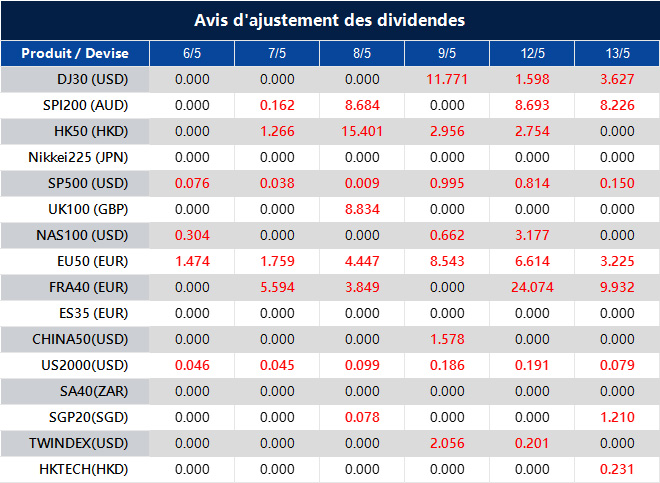
Avis d’ajustement des dividendes – May 06 ,2025

Cher Client,

Veuillez noter que les dividendes des produits suivants seront ajustés en conséquence. Les dividendes des indices seront exécutés séparément via un relevé de solde directement sur votre compte de trading, et le commentaire sera au format suivant : “Div & Nom du produit & Volume net”.

Veuillez consulter le tableau ci-dessous pour plus de détails :

Avis d'ajustement des dividendes

Les données ci-dessus sont fournies à titre de référence uniquement, veuillez consulter le logiciel MT4/MT5 pour des informations précises.

Pour toute information complémentaire, n’hésitez pas à contacter info@vtmarkets.com.

The PBOC will likely set the USD/CNY reference rate at 7.2518, according to Reuters

The People’s Bank of China (PBOC) is anticipated to set the USD/CNY reference rate at 7.2518 according to Reuters. The central bank’s reference rate is expected to be announced around 0115 GMT.

The PBOC employs a managed floating exchange rate system with the yuan, allowing its value to move within a predefined band. This band is currently set at +/- 2% around a central reference rate, also known as the midpoint.

The Role Of The Midpoint

Each morning, the PBOC establishes a midpoint against a currency basket, mainly the US dollar. The midpoint factors in market supply and demand, economic indicators, and international currency fluctuations. This midpoint guides that day’s trading activities for the yuan.

The trading band allows the yuan to move within a designated range around the midpoint. This allows for a potential appreciation or depreciation of up to 2% during a single trading day. The PBOC can amend this range depending on economic conditions and aims.

Should the yuan approach the band’s limit or show excessive volatility, the PBOC may intervene. This involves buying or selling the yuan to stabilise its value, facilitating a controlled adjustment of the currency’s exchange rate.

Balancing Market Dynamics

In effect, what’s happening here is a tightly monitored balancing act. The People’s Bank is not passively observing market developments; it actively shapes expectations and cushions abrupt shifts. By anchoring the midpoint near 7.2518, policymakers are sending a deliberate signal to the market. It isn’t an arbitrary figure – it reflects both international pressure from a strengthening dollar and domestic considerations such as trade competitiveness and capital flow management.

When the central bank sets the reference point at that level, it narrows the field within which the yuan is permitted to fluctuate. This gives us as traders a bounded parameter to work from within the day—no surprises outside that 2% margin unless something unanticipated forces intervention. It also underpins a daily rhythm, a sort of reset button that hints at the central bank’s tolerance for movements, volatility, or divergence from policy goals.

From our perspective in derivatives, the essence lies in predictability and the range. Hedging strategies, spot-future basis calculations, and short-dated vol surfaces all rely on clarity in how far the currency might swing intraday. The fresh midpoint acts as a pivot. If the yuan drifts higher toward the top range, we can reasonably infer which direction intervention risk begins to rise. If the midpoint shifts several days in a row without much market-driven reason, then it’s time to question what underlying goal is being addressed—perhaps import pricing or offshore arbitrage.

The bulk of this is mechanical but intentional. When Liu and other officials allow the exchange rate to walk near the edges of this band without stepping in, it’s a licence for traders to price in tactical risks. But when responses tighten or guidance appears to contradict spot moves, there’s tension to reconcile in options pricing. That’s where volatility premiums begin to reflect not only fundamentals but political will.

So while our eyes might be on interest-rate spreads between regions or on absolute currency reserves, it’s these quiet adjustments—the midpoints, the tweaks to daily references—that function as soft policy tools. They’re hints, not headlines. This week’s projected reference level strongly discourages moves toward appreciating too sharply, signalling preference for a weaker—or at least a contained—yuan.

Expect short-term forwards to lean slightly wider until there’s evidence of stabilising capital flows. In the meantime, any asymmetry between spot and midpoint tells far more than official statements. Transparency isn’t always verbal—it is often numerical. As we build positions, we should shape the structure of our trades to respect that corridor rather than fight against it.

One final practical note: if we observe adjustments that consistently underprice spot moves, the risk isn’t so much outright depreciation but a shift in the band itself. That becomes a different game entirely, requiring recalibration of models that depend on that 2% width. Until then, it’s a matter of tracking daily bias—how far they’re willing to push the boundary without needing to redraw it completely.

Create your live VT Markets account and start trading now.

In April, Spain’s unemployment change decreased to -67.4K, a drop from -13.311K

In April, Spain’s unemployment change was recorded at -67.4K, improving from the previous month’s figure of -13.311K. This adjustment indicates fewer individuals became unemployed during this period.

The data comes with risks, as markets and instruments referenced here are for informational purposes only and not investment advice. Thorough personal research is essential before making any investment decisions.

The Author’s Disclosures

The article author holds no positions in stocks mentioned and does not have business ties with them. Compensation for writing comes solely from the platform.

This information is provided without warranties of accuracy or completeness, and any loss resulting from its use remains the reader’s responsibility. The article aims to inform, not advise on investments.

Spain’s labour market continues to show resilience into the spring. The drop in April’s unemployment figure—by 67,400—is not just a seasonal bump, but a clear improvement from March’s weaker reduction of 13,311. While this isn’t out of historical norms for this time of year, it reflects healthy activity in employment-heavy sectors such as tourism and services, which tend to ramp up ahead of the summer.

From a futures and options perspective, this sort of improvement often signals softening in labour-driven economic pressure. Portable implications follow in rates and spread-based strategies. Less strain on the employment side tends to reduce expectations for aggressive monetary policy swings. We should expect changes in implied volatility, especially in shorter durations, to mirror these updates in real data. That could provide an edge to traders focused on straddles or calendar spreads.

Implications For Traders

What stands out is the pace of improvement. When month-over-month shifts accelerate, especially after a tame March, it forces repricing assumptions linked to macro narratives—Spanish equities, sovereign debt, and regional forex pairs can all show reaction. Derivatives tied to the EUR risk premiums may reflect that in both delta and gamma. Moves like this don’t only shape direction—they shake positioning.

Traders should pay close attention, not just to the headline reductions, but to any changes in the composition of jobs shed or gained. If we see a deeper move into permanent positions or a pick-up in wages, inflation-linked contracts could be quietly repositioning. Options exposed to CPI trends may begin showing heavier skews.

Shorter-term vol windows might tighten this week in response, particularly in instruments oriented around the eurozone periphery. We could see conditional trades adjust their assumptions about downside tails, especially if unemployment rates across other southern European economies follow the same glide path.

It’s not something to chase blindly, but when these types of data releases show unexpected strength—compared both to the prior read and general forecast consensus—they demand a review of the existing positional map. Traders working with exposure in fixed-income legs should re-score the probability of front-end normalisation in European yield curves. Even modest labour tightness can subtly shift where value lies in curve steepeners or flatteners.

The improvement also carries forward into options chains on consumer indices. Decreased joblessness ties directly into spending confidence over time, as more households gain financial certainty. Enough of these months string together, and longer-dated risk reversals on consumer discretionary ETFs begin to look different than they did even a few weeks prior.

As always, this kind of data is a starting point. It doesn’t set prices by itself—it reframes the probabilities that pricing is built upon. That’s the part we need to focus on.

Create your live VT Markets account and start trading now.

Back To Top
server

Bonjour 👋

Comment puis-je vous aider ?

Discutez immédiatement avec notre équipe

Chat en direct

Démarrez une conversation en direct via...

  • Telegram
    hold En attente
  • Bientôt disponible...

Bonjour 👋

Comment puis-je vous aider ?

Telegram

Scannez le code QR avec votre smartphone pour démarrer un chat avec nous, ou cliquez ici.

Vous n’avez pas l’application ou la version de bureau de Telegram installée ? Utilisez plutôt Telegram Web .

QR code