Steady GBP trading is anticipated, aided by political support and potential US-UK trade agreement discussions

Sterling maintains a steady position, with political developments expected to provide supportive dynamics this month. Recently announced is a UK-Indian trade deal, and there is anticipation of a US-UK trade deal potentially concluding this week.

Trade negotiations involve discussions about reducing US tariffs on UK imports, particularly in the car and steel sectors. Attention is also on the 19 May UK-EU summit, the first since Brexit, which may influence sterling movements.

Bank Of England Rate Setting Meeting

The Bank of England’s rate-setting meeting is approaching, with market expectations leaning towards potential rate cuts this year. This context suggests that GBP/USD might revisit the 1.3445 level in upcoming days.

Readers are advised to conduct their own research before making any financial decisions. Any forward-looking statements are speculative and carry inherent risks and uncertainties. Errors, omissions, and risks involved in trading are the reader’s responsibility. The information provided is not intended as investment advice.

With the GBP maintaining its footing, it’s clear that political momentum is playing a part in cushioning near-term price action. The trade agreement with India, while not market-moving on its own, reinforces a broader stance of economic openness, which appears timely given the possible wrap-up of a UK-US trade arrangement. Should this materialise, reduced tensions in the steel and automotive sectors may lift sentiment. These are sectors still sensitive to post-Brexit trade barriers and existing US tariffs.

A key calendar date sits just ahead with the scheduled UK-EU summit on 19 May. While there’s no hard outcome forecasted, this meeting will be the first of its kind since the UK’s formal separation and may provide a platform for discussions about technical alignment or cross-border industry cooperation. Even without headline breakthroughs, renewed diplomatic engagement might ease medium-term uncertainty priced into the pound. For short-dated contracts or weekly options, it’s another potential volatility generator to consider when setting up trades around that window.

Market Observations And Strategies

From a monetary perspective, the Bank of England’s upcoming policy decision adds another dimension. Rates have not budged for some time, but bond markets have started building in expectations that the central bank will start easing before year-end. Bailey’s recent remarks didn’t push back hard against those bets, and if we look at OIS pricing, the implied probability of a cut by Q4 has grown. So, even in the absence of an immediate directional move, the forward curve is starting to drift lower.

From our side, we’ve noted that sterling has respected the 1.3445 level as an anchor point in past sessions when macro catalysts aligned. If sentiment tilts further in the direction of dovish guidance from the Bank or if major trade accords begin to show concrete timelines, then a test of that zone is reasonable to anticipate. Especially if the dollar starts to lose support from yield differentials narrowing.

Liquidity conditions will also matter. With US CPI data scheduled soon, we may see cross-asset volatility widen ranges temporarily, meaning swing trades should favour tight stops and shorter holding periods. Looking further out, risk premiums could shrink slightly if geopolitical risks stay muted and commodities continue stabilising.

We’re watching closely for any divergence between front-end rate expectations and rolling 3-month implied vols, particularly in Gilt markets. A break in correlation here often signals an adjustment phase in FX. If Gilt yields slip without a matching move in sterling, it may disrupt current positioning in GBP pairs and trigger a brief but tradeable decoupling opportunity.

Market participants should consider whether current pricing has already factored in today’s optimism. Keep the bid-ask spreads in mind before entering any relative value positions, especially in exotic pairs that can widen around event dates. The focus isn’t just on directional plays now—but also on how risk is being transferred or hedged, especially in collars and vertical spreads.

Create your live VT Markets account and start trading now.

The PBOC reduced the relending rate to 1.50%, following various prior financial measures for support

The People’s Bank of China (PBOC) will reduce the relending rate by 25 basis points, bringing it down to 1.50%. This change is set to take effect from 7 May.

The relending facility primarily supports the stock market by providing low-cost funding for specific activities. These activities include share buybacks and increasing shareholding by companies.

Series Of Earlier Rate Cuts And Measures

This move is part of a series of earlier rate cuts and measures. These actions have been implemented to support economic objectives.

The People’s Bank of China’s decision to lower its relending rate to 1.50% adds to a sequence of initiatives intended to bring down borrowing costs and direct targeted liquidity into the equity market. The facility, by design, enables financial institutions to tap into cheaper credit with the aim of channelling that money towards corporate buybacks and investment in their own shares. By doing so, the authorities are smoothing conditions for domestic equity valuations and attempting to stabilize investor sentiment.

In the past, these tools have mostly been discreet and narrow in impact, but this adjustment marks a clearer shift towards more visible monetary support. Relending, though not as expansive as traditional rate policy or reserve requirement changes, operates with precision. It supports market functions without the broader inflationary risks tied to general rate cuts.

What we interpret from this update is a reaffirmation of intention from policymakers to anchor equity prices and prevent unwanted volatility fueled by deteriorating confidence. By incentivizing firms to amplify their participation in the market via buybacks or additional shareholding, liquidity is indirectly injected onto trading floors in a relatively controlled fashion.

Near Term Directional Bias For Traders

For traders, this tweak to the relending rate introduces a near-term directional bias that makes downward price pressure in equities less probable, at least domestically. We see this as encouraging for pricing stability, especially in sectors tied to state-owned enterprises or companies with strong government alignment. Volume clusters may shift slightly as market makers factor in greater policy-driven support.

That said, this 25-point reduction does not operate in a vacuum. Traders should be reviewing their volatility assumptions and stress points, particularly in instruments where correlation to Chinese equity indices is high. While the cost of leverage for real economy actors is now a touch lower, the output on pricing remains uneven unless accompanied by pickup in turnover or follow-through in physical cash movement.

Despite the narrow scope of relending itself, adjustments like these signal more, not less, involvement from central authorities. This dampens risk premium in selected strategies — especially short gamma structures or calendar spreads where exposure to institutional buying behaviour could spike.

Liquidity conditions may remain somewhat fragmented during the initial days after the cut takes effect. We would be reviewing skew behaviour in structured products and longer-dated index options, as pricing will likely adjust to potential buying activity from corporates and credit-eligible entities rather than broader retail flows.

In effect, this is a rate cut aimed not at households or broad consumption, but rather at steering behaviour within capital markets. Accordingly, one should not expect the usual knock-on effects seen with base policy reductions — swap curve flattening could even be misleading in this case. Focus should instead rest on positioning shifts among players most responsive to central directives.

Create your live VT Markets account and start trading now.

As the US Dollar gains ground, USD/CHF rebounds above 0.8250, ending its three-day decline

US Officials and Chinese Representatives Meeting

The currency pair halted its three-day losing streak amid a stronger US Dollar as markets await the Fed’s decision. The Fed is expected to keep the benchmark rate at 4.25%–4.50% for a third consecutive meeting in 2025.

US officials are set to meet Chinese representatives, marking a high-level interaction since US tariff increases. China’s Ministry of Commerce confirmed their attendance, reflecting broader global trade dynamics.

While the USD remains firm, the Swiss Franc is supported by safe-haven flows reacting to US policy volatility. Nonetheless, it might face challenges with potential SNB rate cuts, and some analysts foresee a return to negative interest rates.

The SNB’s forex reserves fell for a third month in a row, reaching CHF 702.895 billion in April 2025. Meanwhile, Switzerland’s unemployment rate dropped to a four-month low of 2.8% in April, from 2.9% in previous months.

Shift in Sentiment for USD/CHF

As we’ve seen, USD/CHF lifting above 0.8250 reflects a shift in sentiment, driven primarily by expectations surrounding the Federal Reserve’s upcoming policy stance. With the general view that US interest rates will be held steady in the short term, demand for the greenback has picked up again, halting a recent wavelength of selling pressure. This stabilisation comes after three successive sessions of declines, and suggests traders are leaning into a narrative of relative US resilience, at least in comparison to peers.

The market has effectively priced in a 25 basis-point reduction from the Swiss National Bank in June – a move that stands in contrast to the Fed’s current pause. If that cut materialises, it would widen the interest rate gap between the two currencies. Such divergence is typically conducive to upward momentum in this pair, especially when foreign exchange markets are already gearing themselves for this outcome. We should, however, be noting how quickly consensus can shift in rate futures once data surprises recur.

Diving further into Swiss factors: the recent slip in the SNB’s foreign exchange reserves for a third straight month implies some moderation in intervention. It’s not a trivial figure either – April’s level fell to CHF 702.895 billion, which suggests that authorities may be less active in dampening franc strength via the reserves channel. That might alter how we think about support levels ahead, especially in the event of near-term policy adjustments.

While a lower unemployment reading – now at 2.8% – might typically offer some confidence regarding domestic strength, it hasn’t managed to offset broader bearish expectations for the franc. In fact, the drop from 2.9% represents an improvement, but it probably won’t carry enough forward momentum to counterbalance easier monetary settings. Notably, some corners of the market are weighing the possibility of a return to negative interest territory in Switzerland – a shift that, if it starts to crystalise in commentary or projections, could act as fuel for further upward movement in USD/CHF.

On the global front, high-level interactions between American and Chinese officials are emerging again, which may eventually feed back into broader risk sentiment. Although this doesn’t connect directly to the pair, it does affect the broader dollar tone and investor appetite for safety-linked currencies like the Swiss Franc. For now, we observe that while the franc continues to benefit from some haven flows – possibly reacting to US policy uncertainty – the trajectory is not one-directional, especially when juxtaposed with falling reserve levels and looming rate reductions.

From here, we’re watching for confirmation – not just in the SNB’s decision next month, but in any accompanying language on future guidance. Should the central bank begin laying out a longer path of accommodation, we might see renewed appetite for forward trades targeting higher levels in USD/CHF. The way the dollar holds against peers could reinforce this.

The job for positioning in this environment won’t be simply about reading central bank rate decisions – it’s increasingly about estimating how quickly expectations around them shift. That includes how traders respond to surprise Swiss data or statements that hint at a slowing of further rate cuts. Short-term instruments are particularly sensitive and will likely reflect even modest revisions in policy pathways.

Create your live VT Markets account and start trading now.

Tensions between India and Pakistan escalate, while US-China trade talks and China’s rate cuts commence

The day in Asia was eventful with escalating tensions between India and Pakistan, initial US-China trade talks, and rate cuts from the People’s Bank of China. FX rates, gold, and equities reacted to these developments.

India and Pakistan, both nuclear powers, engaged in cross-border violence with India targeting sites in Pakistan described as “terrorist infrastructure”. This follows a deadly attack in Pahalgam, where 26 civilians were killed, marking the worst incident in 20 years.

Us China Trade Talks

The US and China will convene for formal trade talks in Geneva, aiming to de-escalate current tensions. These discussions involve US Treasury Secretary Scott Bessent and Trade Representative Jamieson Greer meeting China’s Vice Premier He Lifeng.

China announced supportive economic measures, including a 0.5 percentage point cut to the Reserve Requirement Ratio (RRR) and a 10 basis point reduction in the 7-day Reverse Repo rate to 1.4%.

Gold reached above US$3430 before dropping to around US$3360 amidst these news events, stabilising thereafter. The USD gained generally, while the AUD/USD saw fluctuations. US equity index futures rose on the trade talk news, stabilising off their early highs.

This sequence of global developments presents a tightly packed combination of geopolitical risk, policy easing signals, and early diplomatic overtures, each pressing on separate but connected threads of financial market sentiment. The military exchange between Delhi and Islamabad, highly sensitive given the nations’ nuclear status, has injected immediate risk aversion into markets, especially in Asian trading hours. The attack in Pahalgam triggered official action from India that markets may interpret less as a one-off and more as a draft of what’s to come.

From our perspective, individuals and institutions responding to these events through leveraged instruments should consider any further escalation as a variable that compresses volatility expectations only after dislocations occur. Mispriced gamma, particularly in currency options markets, may lead to unexpected convexity exposures unless properly hedged. In volatility markets, implied levels may not entirely match realised movements yet, opening doors but also sharpening risks.

Geneva Meeting Outcomes

Turning attention westward, the meeting scheduled in Geneva appears structured but remains heavily weighted toward restoring a baseline rather than building new terms. Greer and Lifeng represent voices aligned with resolve, but markets read commitment in tone as well as policy releases. Futures traders seemed to react to headlines first, with volumes pressing upward on initial flashes, only to pull back as reality of conditional outcomes took root.

Beijing’s decision to lower the Reserve Requirement Ratio and ease its reverse repo facility falls directly in line with its recent approach of micro-calibrated loosening. The intent, clearly, is to release funding pressure from local financial institutions, make short-term liquidity more accessible, and hold credit lines open without distorting base rates too widely. With the 7-day reverse repo cut to 1.4%, markets now recalibrate expectations for second-half easing paths. We should anticipate more symmetrical pricing movements in CNH vol structures, tilted to the downside near-term.

As for commodities, gold’s sharp two-way move—first above US$3430 before a drop under US$3360—highlights how fragile haven assets become under dual themes: monetary easing and geopolitical stress. Longs may have initiated prematurely, reacting to conflict headlines before fully understanding the easing bias layered in. That retracement could persist in tighter intraday bands, partly as more participants in European timezones digest the picture.

Certain FX pairs illustrate where hedging decisions may have been uncomfortable. USD strength seems squarely informative. Its ascent through the earlier session shows how risk-off flows and rate differential paths together accelerated swap buying demand. In contrast, AUD/USD firmed for a stretch, only to return to a more defensible level. Here, flow-based participants might have found themselves stapled to commodity drivers, while sat on a revised China stimulus narrative.

From our view, we’ll be watching how funding markets adjust, particularly in forward swap points and options collars. With the kind of dislocations these setups breed, small edges vanish unless traders lock in liquidity earlier. Also, index futures—while notably higher—seem to have retraced in step with a moderated tone from press briefings in Geneva. Technicals remain supported, but conviction appears shallow.

We are likely entering a phase where lower-rate liquidity and raised tail risk interaction creates opportunities, though only when positions are sized prudently. Those moving through leverage would be wiser to treat momentum as subject to abrupt fuel stops.

Create your live VT Markets account and start trading now.

The Indian Rupee weakens against the stronger US Dollar amid escalating India-Pakistan geopolitical tensions

The Indian Rupee continues to lose ground against the US Dollar amid increasing geopolitical tensions following India’s strikes under “Operation Sindoor.” These actions were taken after a deadly militant attack in Kashmir, with Pakistan responding by denying involvement and condemning the strikes. Meanwhile, the Reserve Bank of India may intervene to stabilise the market if volatility persists.

The USD/INR pair may face resistance due to India’s low dependence on exports, offering some cushion against US tariffs. Limited capital outflows have supported the INR, although rising US growth concerns have impacted oil prices, a key component of India’s imports. Despite this, India’s inflation rate has recently fallen to its lowest in over five years, while GDP growth has moderated, prompting the RBI to focus on growth concerns.

Us Economic Overview

In the US, the Dollar appreciates as the Federal Reserve is expected to keep interest rates unchanged amidst tariff-related uncertainty. Traders are closely observing upcoming high-level US-China negotiations following recent economic data indicating strength in the services sector. Meanwhile, India is conducting a nationwide mock drill in preparation for potential hostile attacks amid heightened tensions with Pakistan.

The USD/INR pair trades near 84.60, with support seen near 84.10 and resistance around the nine-day Exponential Moving Average at 84.69. A movement beyond these levels could influence the pair’s short-term outlook.

Given what we see now, the Dollar’s strength is being powered largely by the Federal Reserve’s stance — staying firm on rates despite ongoing concerns about tariffs and trade discussions, particularly with China. Powell maintains the central bank’s cautious posture, holding off on rate cuts even with mixed signals from the broader economy. Service sector data showed resilience, reinforcing this “wait and see” approach rather than spurring urgency for any adjustments.

That naturally affects how we approach the Dollar from here — especially as it finds underlying support from these interest rate expectations. No sudden easing means no notable pullback in yield-driven flows. For those of us watching the USD/INR pair, that stability on the US side keeps the pressure tilted slightly upward unless something new pushes the Rupee the other way. At the same time, the Dollar refusing to back down also discourages aggressive bids on INR from overseas investors.

Domestic Monetary Policy And Market Reactions

Turning our attention to the domestic space, RBI’s hesitation to act hastily on rates, particularly after softer inflation data, deserves a look. A five-year low on consumer pricing theoretically gives the central bank more room to loosen policy. Still, current caution suggests that preserving currency stability takes precedence — particularly with military pressures adding new layers of uncertainty. Domestic bond yields reflect this tension. Even though growth has cooled, the central bank stays methodical.

The market’s perception of the Rupee as relatively shielded from external shock — thanks to India’s internal demand focus and modest export reliance — has provided a buffer. But if energy prices start ticking up again, propelled by stronger global demand or refining bottlenecks, that cushion thins out quickly. A jump in oil would stretch the current account, reigniting concerns that had momentarily quieted.

On a technical basis, support around the 84.10 level continues to hold for now, suggesting that buyers remain active just above that line. The resistance at the nine-day EMA around 84.69 has capped recent rallies, but it’s not a firm ceiling. If the pair edges beyond that level — decisively — it opens the door to a move beyond 85 in a fast market. Still, such a break requires either a renewed Dollar surge or a stumble in local confidence.

From where we sit, direction in the coming sessions likely hinges not only on policy or data but on how these heightened military tensions evolve. India’s mock drills may suggest preparation rather than escalation, but the psychological drag on investor sentiment shouldn’t be downplayed. In times like these, shorter-term hedging strategies tend to see more volume. Dated options and forward spreads have already reacted slightly, with premium costs nudging higher compared to last week.

We remain attentive to the combined effects of political severity, central bank restraint, and international negotiation noise. Each of these variables has a way of jolting short-term positioning even without big headlines. The message from the options market is clear — protection is being priced in both ways, with slightly heavier interest on the upside for the Dollar, reflecting caution rather than a directional bet.

That said, short-term trades attempting to front-run any RBI action or price in a policy shift based solely on recent inflation readings may find the risk-reward skewed. The longer hike-volatility holds, the more defensive flows we can expect, particularly if data out of the US continues to impress. Spread widening between US and Indian 10-year yields also plays into this, and we’re watching that carefully.

All told, the USD/INR price zone now stands at a technically and politically reactive point. While a breakout remains possible, momentum will depend not just on external evidence but also on whether domestic events calm down or take a sharper turn.

Create your live VT Markets account and start trading now.

China permits 60 billion yuan from insurance funds for equities, aiming to enhance financial stability and confidence

China plans to increase long-term insurance fund investments in equities by an additional 60 billion yuan (US$8.3 billion). This adjustment is part of an expanded pilot programme to enhance participation in capital markets and is intended to improve financial stability and confidence.

Li Yunze, the leader of China’s top financial authority, disclosed the new measure in a press briefing. Additionally, the authorities are working on new strategies to stabilize the country’s struggling property sector.

Insurance Investment Scheme

The expanded insurance investment scheme is integral to current capital market reforms. Alongside anticipated property sector measures, this change is part of a broader policy strategy to bolster economic resilience against persistent growth and market challenges.

This article points to a fresh injection of long-term insurance capital into Chinese equities, totalling 60 billion yuan. It’s effectively a top-down move to prop up broader financial market confidence. Li says this adjustment is not isolated—it rolls into wider policy efforts aimed at making the economic system sturdier, especially at a time when both investors and institutions remain on edge. There’s also talk of interventions into real estate, which has weighed down China’s consumer sentiment and private investment.

From our perspective, what this means is that the authorities have decided to lean more heavily on institutional resources. Insurance funds, being typically conservative and long-view focused, offer a relatively low-volatility source of capital. We should read this pivot as a message—they’re not depending on short bursts of speculative retail activity, but rather encouraging more steady participation. The hope is that it might reduce major price swings in domestic equities and reinforce internal liquidity when outbound flows are still subject to international headwinds.

As traders in the derivatives space, this adds a clear indication of intent from regulators. More insurance money deployed in listed stocks makes a more stable base for the underlying instruments. This, in turn, may lift implied volatilities less than market activity would otherwise justify. So options premia may not expand in the way some would expect during macro-level uncertainty, because there’s this cushion effect built from institutional inflows.

Potential Market Impact

However, we can’t take it as a signal to relax our awareness. There is talk of further action on property markets, which haven’t yet bottomed out. Measures for that domain are pending, but there’s no guarantee of timing or scope. That risk continues to cast a shadow over banks, developers, and a wide range of indirectly linked shares. So while there may be equity support on paper, some sectors—like construction, steel, or consumer durables tied to housing—might still struggle to find genuine upside momentum.

Also, the fact that this is an expanded pilot implies earlier phases have seen enough satisfaction among policymakers to scale up. That means the original investments, smaller though they may have been, didn’t disrupt pricing or create dislocations. At the same time, derivative traders can interpret this as a cue that interventions of this style and size may recur. There’s now precedent for adding long-term capital systematically if activity levels sag or if valuations decouple from policy targets.

We would suggest mapping short-term positions more carefully to relevant index weightings. Insurers tend to favour stable dividend-providing companies—so that’s likely where the incremental buying pressure will land. Tech growth stocks or speculative counters may not benefit to the same degree. This makes selective hedging via sector-spread positioning a more attractive route than blanket puts or index shorts.

We should also remain ready for abrupt shifts in tone. Nothing in this expansion rules out more abrupt liquidity measures elsewhere. Should stimulus spread to other asset classes, say through offshore credit markets or household wealth products, then the shift could distort correlations. That’s likely to demand fast repricing on multi-asset volatility structures.

In the meantime, we treat this update as a directional tailwind for mainland equities, but with highly specific sector preferences. While that tailwind may suppress expected move premiums short-term, it doesn’t remove tail risk on a quarterly horizon. For now, insurance-led resources flowing into domestic equities should encourage restrained short volatility strategies, especially concentrated around low-dispersion ETFs. However, this still requires close attention to statements from Li’s office, as these remain the clearest forward-looking indicators of tactical policy rotation.

Create your live VT Markets account and start trading now.

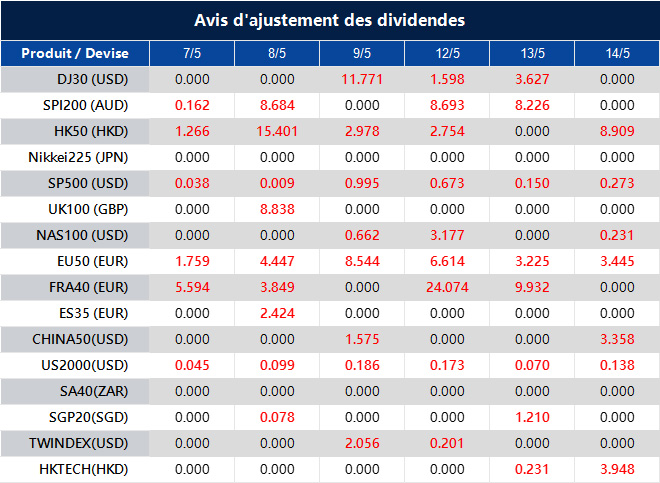
Avis d’ajustement des dividendes – May 07 ,2025

Cher Client,

Veuillez noter que les dividendes des produits suivants seront ajustés en conséquence. Les dividendes des indices seront exécutés séparément via un relevé de solde directement sur votre compte de trading, et le commentaire sera au format suivant : “Div & Nom du produit & Volume net”.

Veuillez consulter le tableau ci-dessous pour plus de détails :

Avis d'ajustement des dividendes

Les données ci-dessus sont fournies à titre de référence uniquement, veuillez consulter le logiciel MT4/MT5 pour des informations précises.

Pour toute information complémentaire, n’hésitez pas à contacter info@vtmarkets.com.

China’s sovereign fund, Central Huijin, plans enhanced support for local stock markets and reforms

The China Securities Regulatory Commission (CSRC) has pledged its support to Central Huijin in bolstering the financial markets. Central Huijin and the People’s Bank of China (PBOC) are functioning as a quasi-stabilisation fund.

China is set to introduce reform measures aimed at enhancing technology boards. Adequate preparations have been established to manage external economic shocks.

Encouraging Long Term Capital

The CSRC intends to actively encourage the infusion of long-term capital into the stock market. Confidence remains high in achieving stable development in China’s stock market environment.

We’re now seeing clearer intentions from the regulators — not idle reassurances, but tangible steps. The CSRC gave its backing to Central Huijin, the state investment arm, reinforcing its role in calming volatility and pumping liquidity where needed. This, coupled with support from the People’s Bank of China, resembles actions seen during periods of domestic stress in past trading cycles, such as in 2015 and 2008. The objective remains clear: reduce panic-driven selling and anchor pricing expectations more firmly.

With preparations laid to shield the financial system from global economic headwinds, there is little ambiguity about what policymakers fear — foreign capital instability, tech stock fragility, and policy tightening overseas. Strengthening the technology boards signals a desire to direct capital flows toward domestic innovation rather than property and infrastructure — sectors that previously drove cycles but are now less favoured. Momentum here could begin impacting risk premiums on relevant contracts, especially those tied to mainland growth sectors.

By stating it will “encourage” long-term money into equities, the CSRC is gesturing to large institutional players — pension funds, insurers, perhaps even sovereign pools. This means an intended shift from short-term, sentiment-driven speculation toward something more anchored, slower moving, but potentially impactful over time. When this kind of participation increases, volatility typically tapers in major indices, and the composition of flows becomes easier to track.

Market Stability and Policy Responses

Liu, in his recent remarks, underscored confidence in achieving steady progress. Layered into the current policy tone is a reminder: the tools remain on hand, and authorities will not hesitate to deploy coordinated effort if market signals begin to weaken abruptly. This is not only a signal to domestic investors but also a calibration point for those watching from offshore.

Over the next one to two weeks, the direction of large-cap indices may become less reactive to news headlines and more driven by policy impact. Short-dated implied volatilities already hint at a ceiling, though relative strength remains with futures tied to tech-heavy boards. Options positioning suggests that recent hedging may unwind in waves if downside triggers fail to materialise. In this scenario, we anticipate dealer gamma exposure to flip more positively, which typically reinforces stability unless intraday volume spikes.

For us, the real takeaway lies in how predictable policy responses are becoming. One could start aligning tactically around that. The implied message from reform efforts and market interventions is stability first — and that’s not usually incompatible with near-term tactical moves, particularly in instruments most closely tied to domestic flows.

Create your live VT Markets account and start trading now.

The PBOC governor announced a 25 bps reduction in structural policy tool interest rates and banks’ deposits

The People’s Bank of China (PBOC) plans to lower interest rates on structural policy tools by 25 basis points. Additionally, they intend to guide banks in reducing deposit rates.

Recently, PBOC Governor Pan Gongsheng noted global uncertainties, prompting interest rate cuts. The PBOC has reduced the 7-day reverse repo rate to 1.4% from 1.5%.

PBOC Responds to Economic Conditions

Further measures include a 10 basis point cut to the Loan Prime Rate (LPR) and a 50 basis point reduction in the required reserve ratio (RRR). These changes reflect the PBOC’s response to prevailing economic conditions.

The announcements out of China point clearly to a central authority keen on stimulating activity amid ongoing economic sluggishness. By shaving 25 basis points off structural policy tools and nudging banks to ease deposit rates, the People’s Bank is trimming borrowing costs to inject more momentum into financing channels. The 7-day reverse repo now sits at 1.4%, a cut from the earlier 1.5%, a move made quietly but matching expectations following months of soft data and global fragility.

Pan’s references to outside uncertainties – the kind typically associated with dollar swings, uneven trade flows, and bouts of market tension – hint that this wasn’t merely a local policy action. Rather, we interpret this as a counterbalance to wider disinflationary pressures, some imported, some home-grown.

The adjustments didn’t stop at overnight liquidity. The Loan Prime Rate has been lowered by 10 basis points, and more notably, the required reserve ratio saw a 50 point trim. For domestic lenders, this frees up cash, allowing them to make credit more accessible without resorting to informal or riskier channels. It tells us very clearly that stabilisation, at least in the short term, has become paramount.

Analyzing Market Implications

In positioning for the next several weeks, it makes sense to consider what these moves imply about volatilities and rate differentials. Existing positions linked to CNH funding costs may be impacted by lowered forwards, while local risk appetite might return in pockets, albeit cautiously and preferentially towards sectors supported by the State’s next wave of guidance.

From our side, careful recalibration of options pricing and spreads will be needed. Watch the term structure across tenors that are uniquely sensitive to policy tweaks – anything with sub-six-month exposure will reflect these rate steps almost immediately in delta and gamma profiles. For anything longer, the implied reaction may be more subdued, unless further easing is introduced.

Consider as well the way in which commercial banks, empowered with both lower funding costs and guided rate ceilings, will reposition their books. Sudden steepeners or flattening trades could become more compelling depending on whether private demand upticks as intended. For us, skew estimates and tail scenarios should be rerun under these adjusted assumptions.

Finally, given the RRR reduction alters base liquidity conditions, pay attention to short-end repo markets, particularly where arbitrage plays might now widen. The pricing of volatility might not immediately reflect the full outcome of the central bank’s decision-making, so patience combined with precise execution will matter more than usual.

Create your live VT Markets account and start trading now.

The pair hovers around 1.1360, showing bullish potential as it tests support near 1.1350

The EUR/USD currency pair is close to testing support around 1.1350, with the potential to revisit the high of 1.1573 from April 21. The Relative Strength Index (RSI) is above 50, showing a bullish trend, and currently, the pair is examining the nine-day Exponential Moving Average (EMA) near 1.1320.

The currency pair is retracting recent progress and is trading near 1.1360 during the Asian session. Technical analysis indicates a bullish trend with the pair positioned in an ascending channel pattern.

Short Term Momentum

Short-term momentum seems strong, as the EUR/USD remains above the nine-day EMA. A retest of the April high is possible, with resistance likely near the ascending channel’s upper boundary at 1.1730.

The nine-day EMA near 1.1320 acts as key support, followed by the channel’s lower boundary around 1.1300. A breach below this area could weaken the bullish trend, potentially reaching the 50-day EMA near 1.1057.

Further downside may soften medium-term momentum, extending losses toward the six-week low of 1.0360. The Euro was the weakest against the US Dollar, with a 0.06% change on the day.

The movement displayed in recent sessions gives us a cleaner picture of what’s driving current behaviour around the EUR/USD pair. We’ve seen the currency pair retrace some of the gains it captured earlier in the week. But on balance, the technical setup leans positive, backed by that RSI reading comfortably above 50, which tends to be interpreted as a continuation of buying interest rather than exhaustion.

Signs Of Consolidation

From our view, the pair is showing early signs of consolidation after a steady incline during previous days. Price action sticking close to the nine-day EMA around 1.1320 is important—not necessarily because it determines upcoming direction on its own, but due to how closely the market has been respecting that level. That EMA is doing its job here, acting as a buffer whenever downside momentum increases intraday. The channel’s anatomy—support at 1.1300 and resistance closer to 1.1730—gives us a framework for judging risk in the approach to higher resistance.

Looking in the other direction, if traders see a decisive daily close below the 1.1300 line, that opens up a different conversation. We’re monitoring the 50-day EMA around 1.1057, as any moves approaching or beneath that level would mark the end of the current uptrend. Short positions would likely begin to build around that stage, especially if accompanied by a declining RSI or longer wicks forming above prices—often signs of demand fading.

It’s easy to get too focused on the short-term candles, but bigger-picture pressure builds as the pair approaches the April highs near 1.1573, a place where sellers previously overwhelmed buyers. That area can’t be ignored. It’s likely to prompt caution among those who’ve been long from lower levels. And unless broader macro factors shift radically, that region acts as a natural checkpoint where upward moves may slow or even turn.

Volatility in peer currencies and reaction to US economic prints may also distort momentum subtly over the coming weeks. That daily 0.06% shift—small as it is—suggests lack of aggression from either side for now, but it won’t remain that way for long. Like most slow starts, they tend to be followed by sharp directional leanings.

Given this setup, we remain attuned to how momentum changes in the zone between 1.1300 and 1.1570. For moves against trend to gather force, a break below the base of the structure followed by rejection on any bounce attempt would validate a more bearish short-term strategy. Layering entries and exits based on EMA alignment with price action remains an efficient way to manage volatility and avoid late commits.

Create your live VT Markets account and start trading now.

Back To Top
server

Bonjour 👋

Comment puis-je vous aider ?

Discutez immédiatement avec notre équipe

Chat en direct

Démarrez une conversation en direct via...

  • Telegram
    hold En attente
  • Bientôt disponible...

Bonjour 👋

Comment puis-je vous aider ?

Telegram

Scannez le code QR avec votre smartphone pour démarrer un chat avec nous, ou cliquez ici.

Vous n’avez pas l’application ou la version de bureau de Telegram installée ? Utilisez plutôt Telegram Web .

QR code