The USD/CAD remains around 1.3800, facing downward pressure from a weakening US Dollar

USD CAD Influence Factors

USD/CAD remains near 1.3800 during Monday’s Asian session, following a previous decline. The US Dollar faces pressure, possibly due to renewed trade tensions after plans to initiate a 100% tariff on foreign-made films were announced.

The US Dollar Index is down for the second day, trading near 99.70. Attention shifts to US ISM Services PMI for further economic insights.

President Trump confirmed Federal Reserve Chair Jerome Powell will keep his position until May 2026. The April Nonfarm Payrolls report exceeded expectations with 177,000 jobs added, and the unemployment rate remains steady at 4.2%.

The Canadian Dollar finds support amid easing recession concerns. Canada’s GDP showed growth despite falling commodity prices and trade dispute fears.

Factors influencing the CAD include interest rates set by the Bank of Canada, Oil prices, economic health, inflation, and trade balance. The Bank of Canada’s goal is to maintain inflation between 1-3%, with higher rates generally supporting the CAD.

Impact Of Oil Prices

Oil being Canada’s largest export, impacts the CAD value – higher prices often strengthen it. Economic indicators such as GDP, employment, and consumer sentiment can also influence the CAD’s direction. A strong economy typically benefits the Canadian Dollar.

Following last week’s adjustment lower, USD/CAD is treading water just below 1.3800 as we move through Monday’s Asian hours, and while the pair may appear relatively stable at first glance, the underlying drivers suggest this balance could be short-lived. The greenback has come under some pressure, most likely triggered by renewed trade protectionism signals – in this case, the push for a 100% tariff on foreign films. While this may seem unrelated to currency flows, the implied protectionist stance fuels broader concerns over international relations and potential retaliation, which tend to weigh on the Dollar when sentiment softens.

On the back of this, the US Dollar Index slipped further for a second day, now flirting with the 99.70 level. That’s telling. From where we sit, it’s clear that the market is now watching domestic service-sector data to understand whether there’s still a firm foundation beneath the broader US economy. With this in mind, the ISM Services PMI reading now takes priority. Any softness there could put further downward pressure on the Dollar, especially if paired with a moderation in Treasury yields.

Powell’s role at the Federal Reserve remains steady through May 2026 following confirmation from Trump, which by itself offered a momentary degree of clarity. What matters more, though, is that April’s jobs report managed to outperform – showing 177,000 positions added, meaning the labour market’s pace, while cooling slightly, still holds firm. The 4.2% unemployment rate staying unchanged reinforces this. Yet, a softer trajectory in wage growth or participation metrics might start shifting rate cut expectations subtly, and it’s worth staying nimble enough to catch that turn.

Moving north, the Canadian Dollar has held relatively firm, aided by diminishing recession chatter after gross domestic product figures showed some resilience. Despite downward pressure from weaker commodity prices and overseas trade alarms, the domestic economy has continued to inch forward. It matters because any hint of sturdiness when others falter becomes a comparative advantage. That’s also tied in with where the Bank of Canada stands on rates.

The BoC wants inflation to stay in that 1-3% area they target. That’s why rate decisions there directly affect CAD direction. Higher rates not only make Canadian assets more attractive, but also suggest they’re operating in a stronger demand environment. Now, if employment or CPI comes in higher than expected, we’d expect markets to start moving pricing away from potential cuts.

Then there’s oil. It’s been softer recently, but we must remember that it serves as more than just a headline for Canada – as a major export, it plays into broader current account flows. When prices climb, Canada benefits on the trade front, offering support for the currency. That said, recent price action in crude has been mixed. So we keep our eye closely on energy demand forecasts and OPEC moves, because any sudden shift there trickles through fairly quickly.

In the meantime, derivative positioning should account for these contrasting signals. While USD softness has crept in, commodity-linked currencies like CAD aren’t on a one-way path higher. There’s tension between firm domestic indicators and external fragilities. Every scheduled release in the coming days – especially from US service sectors or Canadian inflation figures – must be considered not only in isolation, but in how they shift odds on forward guidance. We don’t expect straightforward reactions; we plan for overlapping forces and fading sentiment swings.

Spreads remain key as well. The US-Canada 2-year and 10-year differentials could widen or contract based on Powell’s tone and oil’s next leg. Rather than banking on smooth momentum, we prepare for contained volatility with sharper intraday risk. That means positioning tighter, knowing that a mild retracement doesn’t rule out a renewed breakout – or rejection – near 1.3800.


Create your live VT Markets account and start trading now.

Safe-haven demand supports the Japanese Yen, which shows a slight upward trend against the US Dollar

The Japanese Yen (JPY) has maintained a slight upward trend against the US Dollar (USD) due to renewed safe-haven demand, despite US-China trade tensions showing signs of easing. Concerns related to geopolitical risks continue to influence market sentiment, supporting the JPY. The USD/JPY pair has recoiled towards the 144.00 mark in Asian trading, with the USD experiencing modest weakness.

The Bank of Japan’s (BoJ) recent decision to pause interest rates might deter JPY bulls from aggressive investments. The BoJ has adjusted its economic and inflation forecasts, cooling expectations for an imminent rate hike. Meanwhile, traders are cautious, awaiting the upcoming Federal Open Market Committee (FOMC) meeting, which could impact USD movements and affect the USD/JPY pair.

Political Developments And Safe Haven Demand

Amid political developments, China is considering trade talks with the US, while geopolitical tensions persist, with leaders from Israel and Iran issuing retaliatory threats. Meanwhile, Russia’s President expressed confidence in achieving objectives in Ukraine, driving safe-haven flows towards the Yen.

The JPY is among the most traded global currencies, influenced by various factors, including BoJ policy and bond yield differentials. Although the BoJ’s policies often align with currency control, it generally avoids market interventions. The Yen is perceived as a stable investment option during market volatility.

With recent price action drawing the USD/JPY pair back toward the 144.00 region, we’ve seen risk appetite shifting edgewise, seemingly on broader nerves surrounding geopolitics rather than any particular economic catalyst. Traders still holding long-dollar exposure need to reassess those positions, particularly with moves in Treasury yields suggesting that some risk is being priced out of the system.

Ueda’s decision to hold rates steady at the last Bank of Japan meeting was interpreted as a pause more than a pivot. It’s led to a cooling in Yen optimism, especially among those looking for fast appreciation. Short-term speculative flows had been warmed by the chance of a Japanese policy normalisation, but the revised inflation guidance threw cold water over that. It’s not the kind of environment that invites sharp moves, but rather one where caution continues to dominate—particularly when the currency remains at the mercy of external politics.

Central Bank Expectations And Market Impact

We should also account for how central bank expectations are drifting apart. While Tokyo refuses to flinch from its patient stance, the US Federal Reserve is preparing to either reinforce or soften its language in the upcoming FOMC meeting. Any reinforcement of the higher-for-longer message will give the Dollar support, particularly so if employment or inflation data leave little doubt. On the other hand, even a hint of dovish revision could lower yields and prompt further retracement in USD/JPY.

Looking beyond monetary policy, we are in one of those market periods where the headlines carry a heavier weight than the data prints. Tensions between capitals—Tehran, Jerusalem, and Moscow—have stirred traders into reducing their risk exposure, directing that capital instead into defensive currencies. Given its traditional safe-haven status, the JPY has been the main beneficiary, especially during the Asian session when regional political headlines set the initial tone.

Bond markets are reacting accordingly. Yield differentials continue to play a pivotal role, particularly for derivative positioning tied to the USD/JPY cross. Some traders may be tempted to take advantage of a narrowing spread between Japanese Government Bonds and US Treasuries, even if it’s not yet consistent or predictable. We’ve already noticed a lean towards more cautious straddle setups and reversals in short-dated options as implied volatility firms up.

For traders working within the derivative space, especially those constructing strategies around rate differentials or implied volatility, this is a period where precision and timing are paramount. Week-to-week fluctuations may appear subdued on the surface, but the latent risk premium—fueled by war rhetoric and policy hesitation—is quietly shaping exposure pre-emptively.

We’ve also observed that gamma risk on both sides of the 144.00 mark has crept higher in recent sessions. That’s led to a subtle but clear preference for strategies that minimise directional bias while providing room to absorb breakouts prompted by policy statements or headlines. Existing exposure near key strike levels should be reviewed regularly and adjusted quickly if economic narratives take a sharper turn.

Ultimately, how these political and policy themes continue to feed into derivatives pricing will depend heavily on clarity—or the lack of it—from rate-setters and political figures in the coming fortnight. For now, it remains a game of watching yields and watching words.

Create your live VT Markets account and start trading now.

US President Trump stated he would reduce tariffs on China to facilitate business engagement with them

US President Donald Trump announced plans to eventually lower tariffs on Chinese imports, citing the need for mutual business dealings. No immediate trade deals are expected this week, and there are no plans for talks with China’s Xi Jinping.

The uncertainty surrounding tariffs has impacted the currency market, with the US Dollar Index decreasing by 0.31% to 99.73. This change reflects the ongoing economic tension between the United States and China.

Understanding The Trade War

A trade war refers to economic conflict due to protective trade barriers like tariffs, leading to increased import costs. The US-China trade conflict, initiated in 2018 by Trump, involved tariffs due to disagreements over trade practices and intellectual property. China’s retaliatory tariffs escalated the situation, though the Phase One deal in 2020 aimed to ease tensions.

Donald Trump’s return to the presidency has rekindled trade conflict, threatening to impose 60% tariffs on China. This action from January 2025 sparks renewed economic tensions, impacting global supply chains and contributing to Consumer Price Index inflation. The resumption of policies post-Trump could affect global economic stability and trade dynamics.

Given Trump’s announcement about potential tariff reductions—though with no talks planned nor deals imminent—it’s a signal, not a shift. We’re looking at a rhetorical easing rather than a change in policy. Still, even this hint influences how markets react, particularly in currency and derivatives.

Last week’s Dollar Index slip to 99.73, a 0.31% decline, is less about numbers than about sentiment. The drop captures weakened confidence in trade relations with China following renewed threats of heavy tariffs. That’s the game we’re watching now: not what’s happening immediately, but what’s looming on the near horizon. Currency and interest rate volatility are typically some of the earliest pressure points in these scenarios, and we should expect that to continue in short bursts.

Implications For Derivative Traders

For derivative traders, this backdrop adds a layer of directional uncertainty. It’s clear now that the election implications are not merely speculative—they are being priced into long-term expectations. The rate market is particularly exposed to movements stemming from trade-related inflation. With a proposed 60% tariff in January next year, downstream effects on transport and manufacturing costs should be modelled more precisely. Inflation-linked instruments might see increased hedging activity, and we’re already observing wider spreads in long-duration protection.

Then there is the matter of future monetary policy response, which doesn’t act in a vacuum. Trade frictions affect consumer prices directly, which, in turn, influence central banks’ stances. In our view, the market is watching for strong signals from the Federal Reserve, particularly if tariff policies move from threat to implementation. Traders active in macro-driven strategies should prepare scenarios where trade restrictions push core CPI higher, compelling a hawkish shift from monetary authorities even if growth slows.

Lighthizer, a key architect in earlier trade frameworks, has not re-entered the discussion publicly, but the foundational approach he supported remains intact. Supply chains are familiar with the constriction from 2018 to 2020, and the Phase One agreement only partly unwound those strains. If the rhetoric translates into real-world restrictions, option premiums on multi-national manufacturing equities may begin to reflect expectations for lowered margins and shipment delays.

What we’re doing now is paying close attention to commodities as well. These goods are first affected by any bilateral import restrictions, especially agricultural and tech-related inputs. Derivatives linked to energy and industrial metals could begin to display asymmetric pricing as the speculation around Chinese retaliation develops. Risk skew is growing wider in some agricultural futures, though volume has yet to confirm broader sentiment shifts. That’s where historical cyclicality helps—past trade disputes offer a framework for timing exposure.

Early signals from corporate earnings calls reveal broader concerns about materials sourcing and ability to pass increased input costs to consumers. While that’s not new, we’re seeing a broader reassessment of forward guidance when references to tariffs resurface. Traders positioning around earnings volatility should consider that delayed impacts from trade may not be linear—and could arrive later than expected, particularly if consumer spending remains firm.

In times like this, we draw on market memory. The period between late 2018 and early 2020 established a template. Index options, especially those pegged to exporter-heavy benchmarks, displayed wider beta relative to trade developments. The same may reoccur if tariffs return in full next year. Calendar spreads and structured derivatives may be efficient tools to navigate this—delaying commitment while maintaining optional upside until further policy decisions clarify.

We should also flag that broader risk appetite wanes when trade actions inject pricing noise into inflation metrics. Bond implied volatility often leads that shift, and it is not coincidental that Treasury yields briefly wobbled following Trump’s tariff remark. Traders who operate in correlation-based models may need to actively account for breakpoints between commodity inflation and rate expectations, as assumptions of stable co-movement may not hold in renewed trade tension periods.

So while the lack of ongoing talks between the US and China appears to dampen near-term deal hopes, the forward-looking view from derivatives markets suggests otherwise. No sharp reactions should not be mistaken for complacency—pricing mechanisms are merely adjusting for longer arcs. And that’s where thoughtful positioning comes into play.

Create your live VT Markets account and start trading now.

During Asian trading, WTI prices drop to approximately $55.75 as OPEC+ boosts production levels

West Texas Intermediate (WTI), the US crude oil benchmark, is trading at approximately $55.75 during Asian trading hours on Monday. This follows an agreement by the Organization of the Petroleum Exporting Countries and allies (OPEC+) to raise production by 411,000 barrels per day in June.

The decision by OPEC+ to increase output was made on Saturday, marking a continuation from April’s unexpected hike for May. This move could result in up to 2.2 million barrels per day being reintroduced to the market by November.

Geopolitical Factors

April saw the largest monthly loss in oil prices since 2021, partly due to US tariffs increasing recession fears and slowing demand amid rising production. Geopolitical tensions, such as those in the Middle East, might limit further declines in WTI prices.

WTI Oil is a major crude oil type, also known as “light” and “sweet” due to its low gravity and sulfur content. As a benchmark for oil markets, its price is influenced by factors like global growth, political instability, and currency value.

API and EIA’s weekly oil inventory reports impact WTI Oil prices by indicating supply and demand changes. OPEC’s decisions on production quotas can also significantly impact WTI Oil prices.

From where we currently stand, this latest production decision signals how OPEC+ is proceeding with caution—though simultaneously moving forward in reinstating barrels taken off the table during previous cuts. That increase of 411,000 barrels daily for June, originating from Saturday’s meeting, appears aimed at pacing the build-back of supply whilst avoiding a fresh supply-demand mismatch.

By now, we can presume that if this pattern continues and the full reintegration of 2.2 million barrels per day occurs by November, market participants are likely to experience gradually shifting dynamics in futures pricing. The production volumes re-entering the system, though perhaps manageable in the short term, suggest growing pressure on the lower end of WTI’s current trading corridor, especially as inventories react.

Near Term Volatility

Following April’s sharp descent—the worst seen since 2021—there’s little surprise that geopolitical uncertainty continues to serve as a backstop for further declines. The combination of slowing global demand, sparked in part by trade tensions and recession-related concern, with rising supply hasn’t created the kind of stabilising effect one might normally expect. Instead, it’s added complexity to positions and increased delta sensitivity in shorter-end contracts.

We’re keeping close attention on the API and EIA reports, as changes in inventory figures have typically triggered intraday shifts. Strong builds in crude stocks, particularly at Cushing, can offset the stabilising nerves around geopolitical hotspots, while sharp draws hint at tightening supply that might not be visible in production statistics alone. For those positioned in shorter expiries, the week-over-week data remains essential.

With WTI still holding above $55 but below prior support ranges, near-term volatility linked to any divergence in reported inventory or lingering macro policy rhetoric—particularly from Washington—shouldn’t be underappreciated. There’s also the matter of how quickly newly added barrels reach real consumption markets, as refining capacity and transportation bottlenecks can create time lags that aren’t always priced accurately in the curve.

Brent-WTI spreads may come into play more decisively as arbitrage opportunities arise. A narrower spread could hint at softer export interest in U.S. barrels, while any widening could entice more shipments abroad. For those with exposure to inter-commodity spreads, this movement remains instructive. Furthermore, with WTI’s low sulfur content—its famed “sweetness”—the physical attractiveness of the crude doesn’t always align with headline numbers; thus, basis trades and regional dislocations should be examined closely.

Weekly positioning shifts in the derivatives space have shown a tilt towards hedging, possibly suggesting a wait-and-see approach among institutions rather than aggressive speculation. As we continue tracking these movements, attention should remain on not just the volume added by OPEC+, but also on how regional refiners and global buyers respond through crack spreads and procurement behaviour.

By looking at the futures curve, we’re beginning to notice a mild downward slope near the front—an indication that supply confidence is reasserting itself, at least temporarily. However, watching backwardation’s degree over the next several sessions could offer clues about whether the market still sees tightness ahead or is beginning to price in balance returning faster than expected.

Create your live VT Markets account and start trading now.

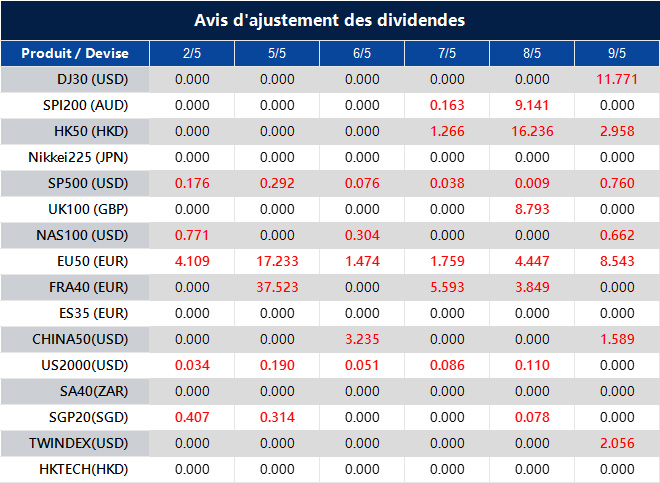
Avis d’ajustement des dividendes – May 02 ,2025

Cher Client,

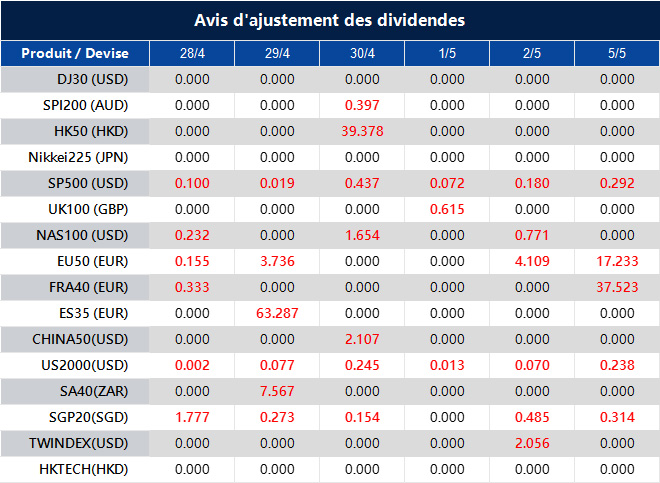
Veuillez noter que les dividendes des produits suivants seront ajustés en conséquence. Les dividendes des indices seront exécutés séparément via un relevé de solde directement sur votre compte de trading, et le commentaire sera au format suivant : “Div & Nom du produit & Volume net”.

Veuillez consulter le tableau ci-dessous pour plus de détails :

Avis d'ajustement des dividendes

Les données ci-dessus sont fournies à titre de référence uniquement, veuillez consulter le logiciel MT4/MT5 pour des informations précises.

Pour toute information complémentaire, n’hésitez pas à contacter info@vtmarkets.com.

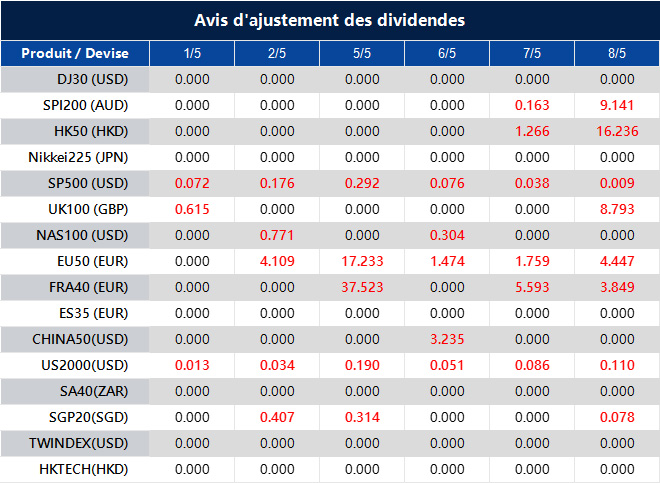
Avis d’ajustement des dividendes – May 01 ,2025

Cher Client,

Veuillez noter que les dividendes des produits suivants seront ajustés en conséquence. Les dividendes des indices seront exécutés séparément via un relevé de solde directement sur votre compte de trading, et le commentaire sera au format suivant : “Div & Nom du produit & Volume net”.

Veuillez consulter le tableau ci-dessous pour plus de détails :

Avis d'ajustement des dividendes

Les données ci-dessus sont fournies à titre de référence uniquement, veuillez consulter le logiciel MT4/MT5 pour des informations précises.

Pour toute information complémentaire, n’hésitez pas à contacter info@vtmarkets.com.

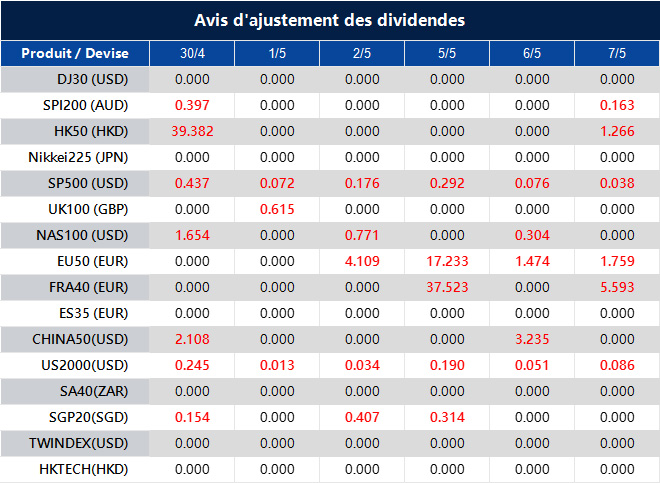
Avis d’ajustement des dividendes – Apr 30 ,2025

Cher Client,

Veuillez noter que les dividendes des produits suivants seront ajustés en conséquence. Les dividendes des indices seront exécutés séparément via un relevé de solde directement sur votre compte de trading, et le commentaire sera au format suivant : “Div & Nom du produit & Volume net”.

Veuillez consulter le tableau ci-dessous pour plus de détails :

Avis d'ajustement des dividendes

Les données ci-dessus sont fournies à titre de référence uniquement, veuillez consulter le logiciel MT4/MT5 pour des informations précises.

Pour toute information complémentaire, n’hésitez pas à contacter info@vtmarkets.com.

Notification d’ajustement de négociation pendant les vacances – Apr 30 ,2025

Cher client,

Affectés par les jours fériés internationaux, les heures de négociation de certains produits VT Markets seront ajustées. Veuillez consulter le lien suivant pour les produits concernés:

Notification d’ajustement de négociation pendant les vacances

Remarque : le tiret (-) indique les heures normales de négociation.

Rappel amical :
Les données ci-dessus sont à titre de référence uniquement, veuillez vous référer au logiciel MT4/MT5 pour des données spécifiques.

Si vous souhaitez plus d’informations, n’hésitez pas à contacter info@vtmarkets.com.

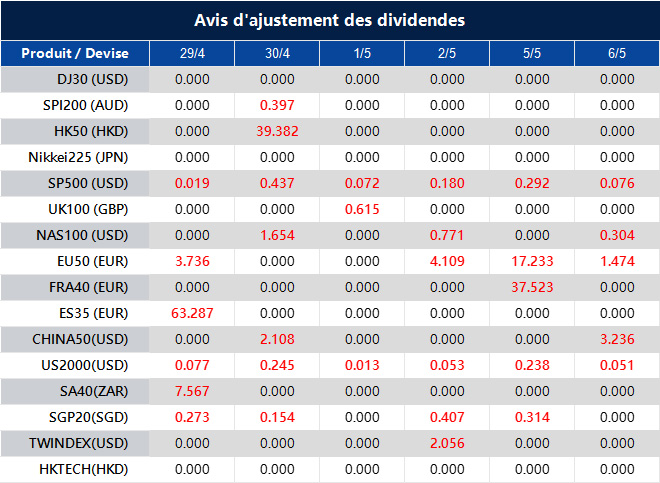
Avis d’ajustement des dividendes – Apr 29 ,2025

Cher Client,

Veuillez noter que les dividendes des produits suivants seront ajustés en conséquence. Les dividendes des indices seront exécutés séparément via un relevé de solde directement sur votre compte de trading, et le commentaire sera au format suivant : “Div & Nom du produit & Volume net”.

Veuillez consulter le tableau ci-dessous pour plus de détails :

Avis d'ajustement des dividendes

Les données ci-dessus sont fournies à titre de référence uniquement, veuillez consulter le logiciel MT4/MT5 pour des informations précises.

Pour toute information complémentaire, n’hésitez pas à contacter info@vtmarkets.com.

Avis d’ajustement des dividendes – Apr 28 ,2025

Cher Client,

Veuillez noter que les dividendes des produits suivants seront ajustés en conséquence. Les dividendes des indices seront exécutés séparément via un relevé de solde directement sur votre compte de trading, et le commentaire sera au format suivant : “Div & Nom du produit & Volume net”.

Veuillez consulter le tableau ci-dessous pour plus de détails :

Avis d'ajustement des dividendes

Les données ci-dessus sont fournies à titre de référence uniquement, veuillez consulter le logiciel MT4/MT5 pour des informations précises.

Pour toute information complémentaire, n’hésitez pas à contacter info@vtmarkets.com.

Back To Top
server

Bonjour 👋

Comment puis-je vous aider ?

Discutez immédiatement avec notre équipe

Chat en direct

Démarrez une conversation en direct via...

  • Telegram
    hold En attente
  • Bientôt disponible...

Bonjour 👋

Comment puis-je vous aider ?

Telegram

Scannez le code QR avec votre smartphone pour démarrer un chat avec nous, ou cliquez ici.

Vous n’avez pas l’application ou la version de bureau de Telegram installée ? Utilisez plutôt Telegram Web .

QR code