Trump’s trade deal hint boosts US equities, prompting increased stock bids amid thinner overnight trading

Trump recently announced a major trade deal in Washington on Thursday morning. This news led to a rise in stock markets, with investors showing positive responses.

The S&P 500, tracked by Globex, experienced an increase following the announcement. However, caution is advised due to the thinner nature of overnight trading compared to regular hours.

Initial Market Reaction

We saw a sharp uptick in the S&P 500 futures following the announcement from Trump, as market participants seemed to price in stronger trade conditions going forward. The reaction was immediate and bullish, particularly in the early Globex session. Although the move was initially swift, much of it occurred when liquidity levels were lower. This tells us the reaction, while encouraging, may not yet be supported by broader participation or conviction.

Globex, because it operates outside standard market hours, typically sees fewer bids and offers, which makes price swings more pronounced. The initial jump, then, was likely exaggerated by that lack of depth. It’s not that the enthusiasm was unfounded, but rather, the full market had not weighed in.

Equity futures received the headline with confidence, suggesting broader expectations of continued support for corporate earnings. However, such movements tend to accelerate technical buying above key levels, especially when larger players aren’t active to provide balance. That means there is a risk of retracement if news momentum fades or if profit-taking sets in.

Powell’s comments earlier in the week about inflation and interest rate policy also continue to weigh on market sentiment in the background. The move in futures may well have blended optimism from the trade announcement with a market still digesting central bank messaging. From our end, we’ve noticed that rate traders have begun adjusting implied volatility levels, largely in short-term contracts, as they attempt to price in the next wave of directional risks heading into the monthly expiry.

There’s also a pattern here we’ve tracked a few times: headlines that hit during overnight sessions tend to spark front-loaded reactions. But the response during US cash hours frequently provides a more grounded take. If price action fails to extend gains when full volume returns, that often suggests the initial push was more headline-chasing than trend-setting.

Opportunities and Risks

We would highlight that implied correlation among major indices remains low, which indicates equities are moving more in response to sector-specific drivers or temporary events, rather than broad-based fundamentals. In that environment, large index futures can become disjointed from the underlying components. That opens opportunity, but it also adds complexity for positioning.

Upticks in volatility—particularly if they appear in skew or downside protection premiums—should not be ignored. Short-dated call options showed early activity after the trade headline, but activity was mostly in contracts about to expire, which tells us traders are still hesitant to build out positions too far forward.

What’s more, we’ve tracked gamma profiles around the 4,500 level on the S&P 500, and any meaningful breach in either direction is likely to result in forced flows from dealers adjusting their hedges. This makes directional moves more exaggerated once those levels are crossed.

Watching how open interest builds after today’s move should reveal how much appetite remains. If followthrough doesn’t take hold during regular trading hours, it would make sense to reassess option deltas to remain neutral or slightly contrarian, especially on days with key economic data.

There are also macro data releases due next week that should not be overlooked. If they don’t confirm the optimism implied today, any long gamma built up on the back of this trade news will be quickly unwound. We’ve noticed in previous cycles that when optimism is pinned on headlines, the skew in derivatives often becomes asymmetric—traders buy short-term upside, but fail to protect against reversal risk.

In summary, while the headline did spur a sharp and visible move in futures, the context in which it came—a thinner market, overlapping macro risks, and limited breadth—suggests that further confirmation is needed before adjusting positioning too aggressively. We continue to monitor order book depth and changes in implied volatility to gauge whether positioning is shifting with genuine conviction or being driven by short-term momentum chasing.
Create your live VT Markets account and start trading now.

With the USD weakening, the EUR/USD pair remains stable above 1.1300, attracting dip-buyers

The EUR/USD pair experienced some buying interest during the Asian session on Thursday, recovering from a previous dip near the resistance zone of 1.1375-1.1380. Despite the uptrend, the pair remains within a familiar range above the 1.1300 mark, amidst ongoing market uncertainties.

Friedrich Merz’s election as Germany’s chancellor eases economic concerns for the Eurozone, providing support for the euro. Concurrently, the US Dollar has failed to gain traction despite the Federal Reserve’s hawkish stance, owing to uncertainties surrounding US trade tariffs raised by Fed Chair Jerome Powell.

Impact Of Us Trade Policy

US trade policy ambiguities, amplified by Trump’s shifting stance and potential EU tariffs on Boeing, discourage assertive market participation. Traders are expected to closely monitor the US Weekly Initial Jobless Claims data and Trump’s upcoming press conference, which may impact USD pricing dynamics.

According to current currency percentage changes, the US Dollar showed strength against the Swiss Franc but faced declines against other major currencies. These fluctuations reflect the complex interplay of market factors, emphasizing the importance of closely following economic and political developments.

While the EUR/USD has pushed upward during the Asian session, this movement can largely be seen as a temporary reaction to earlier selling, rather than a firm breakout. The pair’s attempt to find direction near the 1.1375 mark didn’t fully convince, though the bounce suggests short-term support still holds above 1.1300. We should note that price action remains tightly contained, and that’s telling in itself—volatility is compressed, which often precedes sharper directional moves.

With Merz taking office in Germany, there’s now a clearer fiscal direction in one of the Eurozone’s core economies. Merz is widely seen as fiscally conservative, and his leadership brings expectations of more predictable policy, particularly in regard to Euro-area stimulus spending. That perception has lent the euro a level of steadiness that contrasts with recent swings in the dollar.

Across the Atlantic, Powell’s recent remarks about US trade tariffs haven’t done much to help the greenback. The Federal Reserve has maintained its hawkish tone, but without accompanying policy moves or consensus about the next rate step, traders seem hesitant. There’s still a high level of inconsistency in message versus action. Add to that the unpredictability created by Trump’s posture towards EU trade—the possibility of added tariffs on Boeing hangs in the background—and dollar sentiment becomes muddled.

Market Outlook And Strategies

We’ve also seen some disparity in the dollar’s performance, registering gains against the franc but losing ground elsewhere. That uneven strength reinforces the lack of directional conviction, and here is where derivatives traders need to pay sharp attention.

We are closely watching initial jobless claims out of the US and, more notably, Trump’s scheduled address. Anything surprising in the data or speech could disrupt the current hold pattern. If the job data underwhelms or if rhetoric around tariffs escalates, expect a reaction that overrides technical levels in the short run.

For now, repositioning remains light and sporadic. Traders are reluctant to commit big volume until more clarity emerges from macro news or a clean break above— or below—current boundaries. It’s wise to stay focused on comparative strength indicators and pricing around shorter expiries, where premium adjustments can signal shifts in sentiment before spot moves.

In the absence of strong signals from macro policy, expect underlying options market behaviour to carry extra weight. The skew in EUR/USD calls has started to edge higher, suggesting increasing demand for upside protection. We interpret that as cautious optimism, but not full-blown confidence. Risk premia continue to be unevenly distributed across maturities, giving seasoned participants room to take advantage of mispricings—especially around event dates.

We’ve also noticed a thinning of forward curve pricing around near-term tenors, suggesting that liquidity is being withheld while clarity is pending. In practice, this limits strong directional bets and favours strategies that lean on volatility, rather than outright moves.

Create your live VT Markets account and start trading now.

Today, the PBOC established the yuan midpoint at 7.2073, lower than the predicted figure

The People’s Bank of China (PBOC), the nation’s central bank, is tasked with setting the yuan’s daily midpoint. Within a managed floating exchange rate system, the yuan’s value can fluctuate within a band around this central reference rate, currently at +/- 2%.

Today, the midpoint is set at 7.2073, which is lower than the previous estimate of 7.2385. The prior closing rate was 7.2250.

Reverse Repurchase Agreement

Furthermore, the PBOC has introduced 158.6 billion yuan through a 7-day reverse repurchase agreement at a rate of 1.4%. There are no maturities today, making the net injection 158.6 billion yuan.

The People’s Bank of China (PBOC) has set the yuan’s midpoint weaker today, down to 7.2073 from a previous reference of 7.2385. This adjustment narrows the gap with the prior closing rate of 7.2250. It’s a subtle signal, but deliberate. The central bank appears interested in tempering the yuan’s depreciation pressures without creating sudden volatility, likely in response to both external capital trends and internal liquidity needs. Since the midpoint acts as a baseline around which the yuan is allowed to fluctuate in a controlled band, a lower fixing helps guide market expectations in a slightly stronger direction than the previous day’s close would imply.

Alongside the currency move, we’ve also seen another liquidity operation from the PBOC. The injection—158.6 billion yuan via 7-day reverse repos—is the kind of targeted short-term support we would expect around times of quarter-end settlement or tax payments. It’s deployed at a rate of 1.4%, and the absence of maturing instruments today makes this a full net addition. The scale and method tell us quite a bit. There is a clear preference for shorter-term mechanics rather than longer-term funding commitments, suggesting that authorities believe the squeeze is temporary rather than structural.

For those assessing FX volatility risk through swap points or considering directional trades via USD/CNH, these signals—particularly when looked at together—indicate measured control rather than any urgent intervention. It doesn’t scream panic; it suggests confidence.

Guidance Points

From our point of view, the directionality in the fix combined with increased liquidity via repo actions favours a modestly firm tone in the yuan over the week, all other variables constant. However, without supportive real money flow or a shift in macroeconomic data, traders running leveraged offshore positions should carefully monitor upcoming U.S. data releases and China’s own medium-term funding tools for any tightening signs.

Further out along the curve, there’s scope for increased two-way price action—particularly in the interest rate derivative space—should PBOC tighten the pace or scale of its daily operations. That being said, today’s volume and maturity show little appetite for abrupt tightening. It’s a balancing act being performed with precision. What stands out is where that balance is being struck; close enough to parity to dampen speculative downside, but not so strong as to halt export flow competitiveness.

What we read here are guidance points—small, intentional markers. Each one matters. Temporary positioning adjustments now could make a notable difference by month-end, especially with funding rates stable and forward points not pricing in any sharp directional tilt. Timing entries will be more effective if attention is paid, not only to exchange fixes and injection sizes, but also to the tone of yields across the offshore curve.

Make no mistake, none of today’s data points were accidental—nor should they be treated as routine. Every figure, from the fix to the liquidity measure, points to a maintained caution with clear conviction.

Create your live VT Markets account and start trading now.

The GBP/USD pair trades around 1.3340, recovering following recent declines amid Trump trade policy speculation

The GBP/USD pair saw a rebound, trading around 1.3340, driven by speculation of a forthcoming US-UK trade agreement. Reports suggested that US President Donald Trump might announce the deal, potentially boosting the Pound Sterling.

On Wednesday, GBP/USD dropped by 0.6% as markets leaned towards the US Dollar. The Bank of England was anticipated to announce a rate reduction, following the Federal Reserve’s decision to hold interest rates steady.

Impact Of Trade Tariffs

Federal Reserve Chair Jerome Powell indicated that trade tariffs could hinder objectives for inflation and employment. Despite the impact of tariffs on sentiment, the absence of severe economic data makes immediate rate changes challenging for the Fed.

The pair further fell by over 0.2%, trading near 1.3331, amid increased focus on Powell’s press conference. The Federal Reserve maintained interest rates at 4.25%–4.50% and highlighted concerns over rising inflation and unemployment risks.

What we observed in recent trading sessions is a brief uptick in the British Pound, driven largely by speculation rather than confirmed fundamentals. The suggestion that a trade agreement between the US and the UK could be forthcoming gave the Pound a bit of momentum, with GBP/USD moving toward 1.3340. This was short-lived, however, as downward pressure quickly resumed once sentiment shifted back toward the Dollar.

Wednesday’s 0.6% fall confirmed what many had anticipated: the market continues to favour the Dollar in environments where uncertainty lingers and interest rate paths are unclear. The Bank of England was expected to follow the Federal Reserve’s recent decision to hold rates, although with a softer tone due to more sluggish UK economic indicators.

Powell’s remarks – specifically about tariffs harming both inflation and employment targets – caused a stir. There was a moment of reflection across Dollar assets. But that reaction proved restrained because US data, while not exactly shining, hasn’t provided enough weakness to justify immediate action. That leaves rate traders in holding patterns, hesitant to position too strongly in either direction until stronger cues emerge from economic prints.

Market Pricing And Economic Indicators

As soon as Powell took the podium for his post-decision remarks, the Pound saw renewed weakness. GBP/USD dipped lower to around 1.3331, and this tells us something: markets are still weighing the risks more aggressively on the Dollar side. The US central bank kept rates steady at 4.25% to 4.50% and stressed concerns about inflation holding firm while job market risks bubble beneath the surface. It’s these layered trade-offs — cooling price pressures contrasted with labour market vulnerabilities — that we think create a tricky environment for directional trades.

In the days to come, market pricing in rates and even shorter-term option contracts may continue leaning towards USD strength, especially as policy divergence remains less pronounced but still relevant. For now, it’s the absence of forceful data more than any shocking development that limits further movement. Timing is everything, particularly when rate paths on both sides of the Atlantic are not providing enough daylight for conviction.

Derivatives markets should expect thinner conviction until inflation data on either side surprises or employment readings force central bankers’ hands. In the absence of that, we might see implied volatility remain constrained across short maturity tenors. Options skew has loosened slightly in favour of downside GBP exposure, which fits with sentiment but may not invite large positioning unless catalysts appear.

We’re watching UK macro data closely here — wage growth figures or changes in household spending can push expectations one way or another. Any deviation could prolong pricing inefficiencies across short-dated futures and swaps, offering fleeting opportunities for yield-sensitive strategies.

For now, it’s patience and positioning over prediction. Stay anchored to confirmed data, especially around inflation and employment risk premiums. Trust less in headlines about policy speculation and more in the yield expectations underlying futures and forward curves.

Create your live VT Markets account and start trading now.

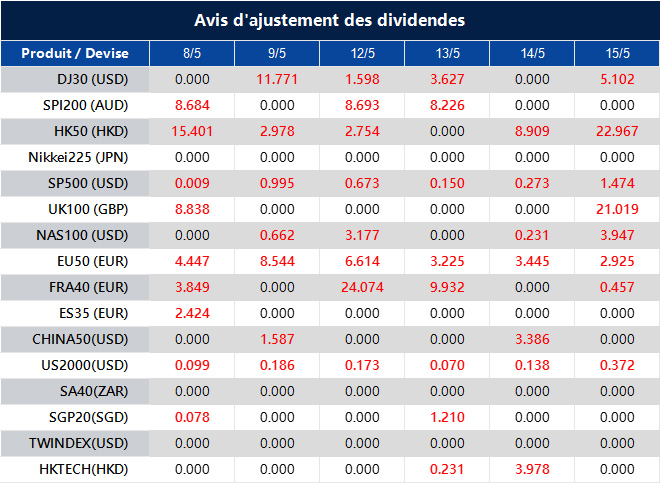
Avis d’ajustement des dividendes – May 08 ,2025

Cher Client,

Veuillez noter que les dividendes des produits suivants seront ajustés en conséquence. Les dividendes des indices seront exécutés séparément via un relevé de solde directement sur votre compte de trading, et le commentaire sera au format suivant : “Div & Nom du produit & Volume net”.

Veuillez consulter le tableau ci-dessous pour plus de détails :

Avis d'ajustement des dividendes

Les données ci-dessus sont fournies à titre de référence uniquement, veuillez consulter le logiciel MT4/MT5 pour des informations précises.

Pour toute information complémentaire, n’hésitez pas à contacter info@vtmarkets.com.

A bill to create a Bitcoin reserve fund has been approved by Arizona’s governor, Hobbs

Arizona has enacted legislation to create a Bitcoin and Digital Assets Reserve Fund. This fund will manage digital assets while restricting Bitcoin from being used for general fund transfers.

The adoption of this law follows the state’s prior rejection of other cryptocurrency legislation. By this action, Arizona aligns with New Hampshire in incorporating Bitcoin into its financial framework.

Arizona’s Digital Asset Strategy

Governor Hobbs has approved the bill, indicating progression in the state’s approach to cryptocurrency. This development represents a notable moment in Arizona’s digital asset strategy.

What this change signals is a deliberate strategy by the state to separate Bitcoin’s function as a reserve asset from its usability in day-to-day budgetary operations. While on the surface it may appear restrictive—excluding Bitcoin from general fund transactions—it actually opens up an avenue for the state to treat Bitcoin more like a long-term store of value, akin to gold or strategic commodities, rather than a spendable currency. By doing so, the fund is insulated from exchange rate volatility affecting public spending while still preserving upside potential.

The fact that lawmakers moved ahead with this model, following earlier failures to push other digital currency-related policies, shows an altered risk appetite among decision-makers. Their change in stance can largely be traced to recent shifts in fiscal policy preferences, combined with broader institutional interest in alternative reserves. The reserve fund becomes one more layer in an overall asset allocation strategy, rather than a tool for disbursement.

Hobbs’ signature, effectively making the bill law, represents forward motion and signals intent rather than finality. We read it as evidence that certain states are now willing to experiment with fiscal reserves in digital form—not to challenge federal currency powers, but to stabilise a portion of their balance sheets in assets that do not fluctuate on the same drivers as fiat-based revenue.

Potential Impact and Observations

The similarities between this move and earlier steps taken in New Hampshire suggest we could be seeing an informal pattern of alignment across states with particular preferences for minimal intervention in financial innovation. It hints at a recognition among some legislatures that, if well-governed, digital reserves might offer efficiencies or diversification benefits—without, however, jumping headfirst into cryptocurrency as a general medium of exchange for public finance.

From where we stand, what matters in the next few weeks is not the legislation itself—which is mostly symbolic while in its early phase—but how stakeholders position themselves around this shift. Those whose positions depend on longer timeframes may interpret Arizona’s move as a soft validation of digital reserves in the context of state finance. Contrast that with the constraints on Bitcoin’s use in general fund transfers, which appears designed to avoid introducing liquidity risks into budgeting.

Markets linked to derivatives may absorb this information with little immediate directional impact. However, one should keep an eye on whether similar reserve funds are proposed in other jurisdictions, particularly where there is current debate around hard asset diversification. In that scenario, hedging strategies may need to adjust not because of one law, but because of broader indications that public entities are willing to treat Bitcoin as a component of treasury strategy.

It’s also worth noting that the character of this fund—effectively passive and disconnected from operational spending—may support pricing stability in contexts where active selloffs tend to trigger downstream effects. We would characterise the weeks ahead as a time to monitor legislative activity in adjacent states, liquidity inflows into existing Bitcoin funds, and whether models of public endorsement translate into material changes in allocation by state-level institutions.

Create your live VT Markets account and start trading now.

During the Asian session, buying interest in silver rises, pushing prices towards the $33.20 mark

Silver’s Appeal In Diversification

Silver (XAG/USD) experiences renewed buying interest during the Asian session, reversing a large portion of the previous day’s decline from a one-week high. The metal reaches the $33.00 range and seems set for further appreciation.

Technical analysis suggests a bullish flag pattern, with oscillators on daily and hourly charts reflecting a positive outlook. However, a breakout above the $33.20 trend-channel resistance is needed for further gains.

Should this occur, Silver may target the $33.70 level and potentially reclaim $34.00, offering new opportunities for buyers. Support is expected around the $32.50-$32.45 area, with the next significant support near $31.60-$31.55.

Silver, less popular than Gold, is valued as a diversification tool, hedge during inflation, or investment in various forms. Silver prices are influenced by geopolitical tension, recession fears, interest rates, and the US Dollar’s performance.

Factors like investment demand, mining supply, and recycling rates impact prices. Silver’s industrial applications, especially in electronics and solar energy, also affect its valuation. It often moves closely with Gold, with the Gold/Silver ratio influencing market perception of value between these metals.

Momentum Indicators and Resistance

A notable observation can be drawn from the relative behaviour of the oscillators that track momentum and price strength. Both daily and intraday indicators signal ongoing positive pressure, which supports further upside moves. However, until silver convincingly crosses the $33.20 resistance level—formed by the upper edge of the current descending channel—we maintain a cautious view on chasing upside. Resistance zones like this often act as temporary ceilings, where price reacts before selecting its next move.

Should $33.20 be breached with volume and confirmation, then targets begin to widen. The $33.70 marker is in view first, which coincides with where the price encountered supply last month. Clear-through that range opens the door for a potential return to $34.00, a psychological area and past structural high that may attract attention. These levels may offer setups, but only with well-defined risk.

Support remains fairly well-defined as well. The $32.50 down to $32.45 band appears to be providing some footing. We’ll be monitoring that region closely if the price weakens, as breakouts often experience retests. A more substantial test of resolve would come near $31.60–$31.55, where previous positions could unwind and force hands.

From a broader perspective, white metals continue to reflect a mixed story. Fears around stagflation and slower global industrial activity would normally weigh on sentiment here due to silver’s dual role as both a monetary metal and an industrial input. But that has been offset in part by inflation hedging behaviour during times of falling purchasing power and political instability. Elevated tensions globally and uncertainty in currency markets may prolong this bid, especially when real yields adjust.

Fed commentary and rate trajectories remain central to directional swings in the Dollar, to which silver is inversely sensitive. A softer greenback, particularly when driven by shifting forward guidance, often lends support here. This correlation is quite intact and adds weight to timing around macro releases and speeches. Even minor shifts in narrative have fast-tracked price swings in recent weeks.

We can’t ignore that supply chains and mining output numbers haven’t returned to full throttle just yet. Primary silver production, especially in Latin American nations, continues to encounter spotty disruptions. That’s fed a basic supply imbalance, which adds a layer of support beneath prices, especially when inventory restocking or speculative demand quietly builds.

Industrial usage, especially in green energy and electronics, is another factor that quietly anchors silver. Recent developments in photovoltaic demand are worth tracking. Any announcement or policy nudge on climate subsidies tends to indirectly strengthen the industrial case. Meanwhile, the Gold/Silver ratio is trading near levels consistent with relative undervaluation. When that ratio compresses, it often reflects stronger flows into silver or shifting preferences among allocators.

With several technical and macro variables aligning—or in some cases, conflicting—traders must remain decisive and short-term oriented while being aware of broader structures. Timing and position size will carry more weight in pace-driven trades. Each resistance break should be measured not just by price, but by follow-through intent. Misjudging that can be costly in thin trading conditions.

For those adjusting exposure or recalibrating macro bias, Friday’s PCE data and US rate expectations will likely serve as the next primary catalyst. From there, we’ll reassess.

Create your live VT Markets account and start trading now.

Support for Ueda’s normalisation was expressed by former BOJ Governor Kuroda, urging calm amidst turmoil

Former Bank of Japan Governor Kuroda suggested a calm approach to Trump’s tariffs, advising that Japan should “sit down and respond” to U.S. policy changes. He critiqued the tariffs, suggesting they could escalate inflation to 4–5% by early autumn, negatively impacting U.S. consumption and growth.

Kuroda pointed out that U.S. policy uncertainty is already deterring U.S. business investment, which could affect long-term U.S. growth. He mentioned that Japan might gain from shifts in demand toward Japanese exports if U.S.-China tariffs persist. Kuroda dismissed any current talks of a second Plaza Accord and weakening the dollar, in spite of market unpredictability.

Bank of Japan Policy and Global Uncertainties

Regarding Bank of Japan policy, Kuroda supported Governor Ueda’s moves toward normalisation, considering the shift away from deflation as “appropriate”. However, he warned that potential rate hikes might be delayed due to global uncertainties.

Kuroda’s remarks serve as a calculated reminder that measured responses can often yield more durable outcomes than abrupt ones. His take on tariffs, particularly those introduced by the former U.S. administration, implies that while they are branded as necessary for domestic protection, they may carry heavier downstream effects. According to him, a rise in inflation to anywhere between four and five percent could tighten household budgets and reduce purchasing power, all while making it more expensive for businesses to borrow and invest. In that context, consumption slows down, expansion weakens, and uncertainty seeps deeper into markets.

By referencing a slowdown in U.S. business investment, Kuroda subtly points to hesitation in boardrooms that weigh future returns against a backdrop of inconsistent signals. This hesitation is not small—it could weigh on productivity gains and soften hiring plans. Over time, rather than driving innovation, firms may wait. This kind of pause adds pressure to monetary policymakers and clouds forward guidance.

We understand that shifting trade routes and supply chains may offer opportunities—morally neutral but economically advantageous for some exporters. If tariffs remain between two large economies, then others can find space to meet demand gaps. He implies Japan could benefit through redirected trade flows, benefiting from the dislocation rather than being caught directly in the policy shifts. However, we should be cautious not to see this silver lining as free upside. With each tariff decision, there are consequences that eventually interact with currency markets and capital allocation.

Monetary Policy Decisions and Global Dependencies

On the matter of monetary policy, Kuroda’s support for Ueda’s steps shows continuity but also invites patience. He sees the normalisation process as justified following decades of below-target inflation. The exit from persistent deflation has taken long years of stimulus and communication, so abrupt course changes would not be welcome. Still, he is mindful of external variables.

We interpret his caution over rate increases as a reflection of how exposed Japan’s monetary plans still are to what happens abroad. Global supply chains, energy prices, and investment flows could delay domestic decisions. The idea isn’t that a rate hike is off the table—but rather, that its timing cannot be assumed based on domestic indicators alone.

In the weeks ahead, it will be essential to monitor inflation prints in the U.S. and Japan closely. Policymakers are watching services, wages, and underlying price pressures. Any pickup in volatility might not come from expected sources.

Strategic engagement should follow economic signals, not political headlines. Option structures might lean toward longer expiries in response to uncertainty around rate paths or trade tensions. Any hedging related to dollar-yen should consider historical responses to trade disruption, not hypothetical accords.

Kuroda has made it clear: don’t expect coordinated currency agreements. Those looking for policy symmetry should instead focus on fiscal-monetary divergence and capital movement trends.

We’re reminded that every pricing decision is, in part, a judgement on stability.

Create your live VT Markets account and start trading now.

Speculation about a US-UK trade deal boosts GBP/USD, with the pair rising to around 1.3350

GBP/USD rises to near 1.3350 as speculation grows over a potential US-UK trade deal under President Trump’s administration. The US Dollar may gain momentum with the Federal Reserve’s cautious stance on monetary policy.

During the Asian session, GBP/USD recovers from recent declines, trading near 1.3340. The anticipation of the trade deal announcement fuels the Pound Sterling’s recovery.

Trade Agreement Speculation

US President Trump is expected to reveal the trade agreement, though this has yet to be confirmed. Meanwhile, the US Dollar Index, measuring the Dollar against six major currencies, stands around 99.70.

The Federal Reserve’s latest meeting kept interest rates at 4.25%–4.50% due to inflation and unemployment worries. Fed Chair Jerome Powell acknowledged trade tariffs could hinder inflation and employment goals in 2025.

The Pound Sterling is the world’s oldest currency and ranks fourth in global trading, accounting for 12% of foreign exchange transactions. The Bank of England’s interest rate decisions, influenced by inflation and economic data, directly affect the currency’s value.

Economic indicators like GDP, PMIs, and employment figures significantly influence the Pound. A country’s Trade Balance also affects currency strength, with positive balances generally enhancing currency value.

Currency Market Dynamics

With GBP/USD hovering near 1.3350, the pair has clearly responded to fresh speculation around a potential trade agreement between the United Kingdom and the United States under the administration of President Trump. While formal confirmation remains absent, pricing in of forward-looking news has historically been a catalyst for shifts in currency valuations, and evidently, traders are tilting their exposure in anticipation. The speculation—combined with the possibility of more favourable terms for UK exports—has lent short-term support to the Pound.

From our perspective, the modest recovery seen during the Asian session, with GBP/USD bouncing back from earlier declines into the 1.3340 range, reflects renewed interest from buyers who may be seeking to capitalise on perceived political tailwinds. However, the UK currency remains fundamentally tied to economic data and policy decisions, meaning macro indicators must still be monitored closely in the week ahead.

On the other side of the pair, the Dollar has been showing limited directional strength in the past few sessions, trading in a relatively tight range against a basket of currencies. With the US Dollar Index sitting around 99.70, it seems the market is taking a balanced view. The cautious tone adopted by the Federal Reserve appears to be keeping a cap on aggressive Dollar buying. Their decision to leave interest rates on hold at 4.25%–4.50%, outlined in their latest meeting, reflects ongoing reservations about inflation control and labour market sustainability.

Powell’s comments, where he highlighted the challenges posed by trade tariffs to inflation targets and employment prospects by 2025, are noteworthy. This gives us an insight into the Fed’s internal recalibration—less willingness to act aggressively in the near term unless data forces their hand. For interest-rate sensitive instruments, this points to reduced volatility forecasts unless headline figures deviate meaningfully from expectations.

Meanwhile, the Pound’s identity as a top actively traded global currency, supported in part by its 12% share in global FX turnover, lends the pair its typical liquidity. Even so, strength in the currency frequently tracks closely with the Bank of England’s interest rate trajectory. We must therefore keep a close watch on incoming price, employment, and GDP data, particularly in sectors disproportionately affected by trade developments.

Currently, the trade balance trend has leaned less favourable for the UK, but any resurgence in exports—suggested as a possible outcome of a new deal—could shift sentiment. Whether the Bank of England will interpret this as medium-term inflationary or a win for broader economic activity remains to be seen. Markets with high forward rate sensitivity, such as short-term Sterling contracts, could react quickly.

Until more tangible policy action or economic print emerges, we are watching short-term support and resistance levels closely. Momentum traders may view the 1.3350 handle as a short-term inflection point, while others may adopt a wait-and-see approach depending on signals from either central bank or further political developments. Respecting scheduled economic data remains essential. Holding positions through volatility tied to headline risk—particularly unconfirmed political announcements—requires tight risk parameters.

Create your live VT Markets account and start trading now.

Plans for a U.S. sovereign wealth fund are being drafted by Treasury and Commerce departments

The U.S. Treasury and Commerce departments are working on plans for a sovereign wealth fund. The White House has not finalised any decisions.

Initiated by Trump in February, the aim is to use government-held assets to benefit the public and enhance economic security. A potential component involves using tariff revenues as a primary funding source.

Sovereign Wealth Fund Models

Treasury Secretary Scott Bessent is exploring how to utilise both liquid reserves and domestic assets. The proposed fund could integrate investment and development functions, similar to models used by other countries.

The White House stated that this proposal is part of a larger strategy. The goal is to use all available resources to protect U.S. national and economic security.

What we’re seeing here is an early-stage policy initiative exploring whether to structure a government-controlled investment vehicle. The suggestion is to create something similar to sovereign wealth funds in other nations – think of Singapore’s GIC or Norway’s Government Pension Fund. While the administration hasn’t committed to one design, the direction is relatively clear: gather up certain public assets and find a way to turn them into something that earns. Preferably, it should earn consistently, over time, and in a way that also reinforces control over economic levers.

Bessent has been tasked with exploring the practicalities – what exactly could be pooled, how liquid those holdings really are, and under what laws they can be deployed. By using both short-term reserves and longer-term holdings, the idea seems to lean into dual objectives: generate yield while also supporting targeted sectors more strategically. It’s been implied that tariff income may serve as the initial inflow, at least partly. That has implications that aren’t negligible – we may see more dependence on import levies precisely because they could feed this fund.

Potential Market Impacts

For those of us watching volatility and yield shifts over short durations, this hints at a different state dynamic entering the financial system. State-directed capital tends to move on political cycles more than market ones. If this fund gets traction, the transmission mechanisms could change. If tariff flows are routed through it, that might mean less liquidity returning via standard Treasury operations. Repo markets could feel it almost immediately – auctions and IBs will have to discount a broader political risk spectrum.

We should also consider the policy sequencing here. With Bessent front-footing reserve strategy, and the Commerce Department aligning on development goals, there could be a longer-dated change to how the U.S. thinks about public capital. What matters more for us, though, is this: the fund, if confirmed, will likely become a tool for policy implementation, not just balance-sheet performance. It could shift correlations, particularly in rate futures and inflation-linked products, as it channels money based on domestic priorities rather than market signals.

Meanwhile, decisions remain unconfirmed, and that’s important. Not because they won’t happen but because timelines will remain in flux. What markets hate more than an unfriendly policy is one that’s half-shaped. For the next few weeks, any hint from Treasury officials or committee chairs should be weighed more heavily than usual. Bond desk chatter will likely start moving before official updates do. There’s no downside to watching flow data with a tighter lens.

Lastly, the reference to national and economic security isn’t accidental. This effort is not being framed as just another fiscal experiment. It’s been placed squarely under strategic interests. That should be taken to mean these funds, if they emerge, are not just targeting return – they’ll be deployed with intentional direction. Which sectors, which regions, and at what pace – all those choices will carry policy meaning. In fast-moving rate environments, that kind of directional bias matters for how spreads widen or tighten, and how volatility is priced. Keep that close.

Create your live VT Markets account and start trading now.

Back To Top
server

Bonjour 👋

Comment puis-je vous aider ?

Discutez immédiatement avec notre équipe

Chat en direct

Démarrez une conversation en direct via...

  • Telegram
    hold En attente
  • Bientôt disponible...

Bonjour 👋

Comment puis-je vous aider ?

Telegram

Scannez le code QR avec votre smartphone pour démarrer un chat avec nous, ou cliquez ici.

Vous n’avez pas l’application ou la version de bureau de Telegram installée ? Utilisez plutôt Telegram Web .

QR code