Concerns over tariffs and OPEC+’s output increases impede oil prices, risking further declines ahead

OPEC+ has announced plans to increase oil output significantly, with warnings about ending voluntary cuts if compliance falls short. This move comes amidst concerns about tariffs affecting global growth and ongoing tensions in the US-China trade war, which are impacting oil prices negatively.

WTI crude has dropped over 3%, opening at a lower price. The struggle is evident as OPEC+ aims to secure market share, potentially edging out US shale. The current situation raises questions about the future balance in the oil market.

Crude Oil Prices Sitting Near April Low

The price of crude oil is hovering near the April low of $55.15, with potential for a further decline if current conditions persist. The uncertainty in the market suggests caution is needed before considering investing in oil stocks currently.

The article discusses recent decisions by OPEC+ to raise oil production and potentially retract voluntary cuts if member compliance wanes. These policy shifts, paired with headwinds such as global tariff disputes and continued trade tensions between the United States and China, are applying downward pressure to oil prices. As a result, West Texas Intermediate crude has slipped by more than 3 percent, reflecting growing concern that supply could outpace demand in the short term.

With current levels dipping near the April low—around $55.15—it signals soft demand amidst geopolitical friction and economic slowdown fears, both of which are difficult to untangle from the broader market narrative. The decision by OPEC+ is not merely about supply increase; it’s also a warning mechanism. There’s a clear message about expectations of discipline within the group, tied closely to a desire to maintain relevance against increased US shale production.

As crude continues to flirt with technical supports—levels that, if breached, often trigger further selling—it gives us a challenging backdrop for positioning. If prices stay pressured and fall below that April threshold, it could induce fresh downside momentum. There’s little in the data suggesting that buyers will intervene aggressively without a shift in macro tone or inventory surprises.

Considerations For Strategic Positioning

In the context of derivatives, what we’re watching is volatility inching higher while fundamentals still point to oversupply. This combination doesn’t favour one-sided positions over multiple sessions. We see options volume remaining lively around shorter expiries, reflecting attempts to hedge sudden moves rather than long-term conviction. That tendency belts in with compressed calendar spreads, suggesting market participants are bracing for sharper near-term fluctuations before reassessing further out.

This also tempers any hope of predictable trends. The breakdown of previous support zones hints at bruised sentiment. There’s a risk here of overinterpreting every price tick, so chasing strength within intraday rebounds may do more damage than good. Instead, we’d rather keep exposure balanced and lean into shorter duration structures while implied volatility remains suppressed compared to historical ranges.

Strategically, the way forward appears to be not about making big directional bets, but focusing more on reacting to price movement rather than forecasting it. There’s value in observing how forward curves shape up in the next several days—particularly around deferred months—as a proxy for longer-term demand expectations. If premiums fade further out, we’ll be inclined to believe sentiment remains guarded.

The messages from OPEC+ were not ambiguous. The choice to increase production now comes with strings: behave or flexibility is withdrawn. That type of policy communication can rattle markets prone to uncertainty even without clear economic signals. We’re watching export flows and refinery uptimes closely, as those often move before headline price adjustments occur.

The next few weeks could reward patience more than aggression. Execution risk is elevated, and spreads aren’t offering much forgiveness. Responses should be rearranged around price discipline rather than conviction in recovery.

Create your live VT Markets account and start trading now.

Details regarding the May 5 New York cut for FX option expiries are listed below

Financial Data Summary

EUR/USD option expiries feature amounts including 1.1 billion at 1.1150, 2.4 billion at 1.1200, 1.9 billion both at 1.1285 and 1.1300, and 1 billion at 1.1400. GBP/USD shows 422 million at 1.3500.

USD/JPY reflects an expiry of 1 billion at 145.50, while AUD/USD has 904 million at 0.6300 and 1 billion at 0.6550. USD/CAD includes amounts of 1.2 billion at 1.3865 and 2.1 billion at 1.3870.

NZD/USD presents 757 million at 0.5900, and EUR/GBP shows 821 million at 0.8525. This financial data is informational and not meant as buying or selling advice.

It is advised to conduct thorough research before making any financial decisions. There are no guarantees regarding the accuracy or timeliness of this data.

The current notional values sitting near key strike levels across several majors suggest a week that could be dominated by positioning into and around upcoming expiries. From our reading of the open interest clusters, traders appear to be focusing concentration near pivotal psychological and technical points.

Market Analysis and Projections

The euro, in particular, appears to have substantial gravity around the 1.1200 strike, where the single largest expiry at 2.4 billion stands. There’s a secondary layer of weight at 1.1300 with nearly two billion, echoing a similar amount at 1.1285. Together, these clusters may limit drift beyond the top end unless momentum forces material movement. If spot hovers in that 1285-to-1300 window heading into expiry, flows from hedging and gamma positioning could keep it tethered just under. Below, 1.1150’s 1.1 billion serves as a counterweight; we’d expect quieter action unless there’s a broader shift in rate expectations or macro inputs.

For sterling, the positioning is far more muted by comparison. The 422 million at 1.3500 is meaningful but not large enough to suggest strong pull or protection unless GBP/USD trades close to that figure. Should spot move nearer to that level in the final hours before expiry, short-term traders may view that as a potential pin point, but otherwise interest is relatively contained.

Turning to the yen, the 1 billion expiry at 145.50 is firm and lies around an area that has seen resistance in recent weeks. If price holds above or moves towards that level nearing cut-off time, flows tied to that option could provide a barrier for further upside—or a magnet, depending on the broader dollar trend. This will be particularly sensitive to any shifts in U.S. yields or policy talk, especially considering how fast the pair has responded to Fed tone changes recently.

The Aussie market displays fairly well-sized expiries at both 0.6300 and 0.6550. Neither is negligible, meaning we have two zones of option-driven interest marking near-term brackets. We’d interpret those as corridor markers—if spot moves inside, hedging behaviour could repress volatility further, while crossing either may be met with an acceleration as those positions decay or hedge adjustments flip.

USD/CAD shows concentrated expiries sitting very close together, with 1.2 billion at 1.3865 and over two billion just 5 pips higher. This kind of layering typically has a strong influence on price action when the underlying is within reach. The tight spacing and considerable notional suggest a strong gravitation point. Short-term setups could gravitate around this setup, especially if North American data releases or oil markets give CAD any directional nudge. If spot closes in near the cluster, it may restrict price discovery until the expiry clears.

NZD/USD has 757 million positioned at 0.5900. Though less weighted than others, it still holds some sway if spot ends up nearby—basic gamma effects may suppress movement should we remain under low volatility conditions. That said, thin positioning elsewhere means we’re less likely to see large positional unwinds or pin moves.

For EUR/GBP, the expiry at 0.8525 at just over 800 million euros isn’t overly dominant but is still hefty enough to shape short-term setups. The level is not far from common pivot zones over the past month, and if euro or sterling price action grows disorderly elsewhere, interest around this strike could spike in relevance.

Going forward, we expect expiry-driven pressure near tightly clustered regions to remain influential throughout the week. We should consider how price behaves in relation to these strike levels, particularly in situations where macro drivers are notably absent or muted. Watching implied volatility shifts and the rate of spot movements near the large expiry zones will be key for selecting the most responsive intraday setups.

Create your live VT Markets account and start trading now.

A few FX option expiries for EUR/USD are unlikely to cause much market impact today

FX option expiries for 5 May at 10 am in New York focus on EUR/USD at 1.1300 and 1.1400, with current prices falling between these levels. These expiries are noticeable but are unlikely to impact the market significantly, as they don’t align with key technical levels.

The expiry at 1.1300 might curb downside movements, while upward movements are restricted by hourly moving averages at 1.1340-53. However, market dynamics and USD sentiment are more influential than the expiries at present.

Current Market Environment

Today, the USD is experiencing weakness amid a subdued risk mood. S&P 500 futures are down 0.7%, contributing to a broader USD decline. This information is essential for assessing the current market environment.

The original article outlines how certain FX option expiries for the euro-dollar exchange rate, specifically at 1.1300 and 1.1400, are not expected to exert much influence on trading direction. Prices are caught between these levels, but the lack of alignment with high-volume technical points limits their impact. There is still some possibility that the lower expiry could act as a soft buffer should prices drift downward. However, when traders glance at the hourly charts, they can see resistance forming around the 1.1340–1.1353 range due to shorter-term moving averages.

Elsewhere, larger macro themes are pressing harder on the market. Right now, the dollar is weakening, and that’s largely being shaped by a risk-off tone sweeping across broader assets. A 0.7% slide in S&P 500 futures is dragging investor sentiment. The dollar, when combined with risk appetite, often underperforms in such settings. Index-linked movement from US equity futures remains a helpful barometer for gauging pressure on other asset classes.

Looking Ahead

Looking ahead to the coming days, open positioning near the 1.1300 expiry could naturally create friction if downward dollar momentum continues. Still, attention may need to shift away from expiry-driven setups. With directional cues mainly coming from global risk behaviour and positioning in US assets, we should anticipate FX options reacting more as passengers than drivers for the moment.

Users who engage in rate-sensitive instruments might instead monitor yield spreads or front-end rate expectations, especially as we approach key central bank commentary. Weekly movements in Fed Funds futures now serve as a core input, since short-term interest rate expectations are gradually positioning for tighter conditions, albeit without a clear timeline. No large macro releases today, but we cannot ignore how much implied volatility has compressed, making short-dated straddles poor value in many major pairs.

From a positioning perspective, there’s also a broader slowdown in aggressive USD buying. That lines up with recent contractions seen in US bond yields, where 2-year notes have pulled back modestly from weekly highs. The retreat in yields reflects a pause in rate speculation rather than endorsement of any policy pivot. Short sellers of the USD may find it harder to press gains unless we see renewed signs of equity softness or cracks in job market indicators.

Traders who typically lean on expiry data should consider side-stepping this week’s cluster. Open interest levels are not abnormally high and have minimal proximity to moving technical thresholds. That means the expiry zones are less likely to create a reaction unless price reaches one coincidentally. We view technical resistance closer to 1.1350 as more tradeable than options defence at preset levels.

In practice, positioning will respond faster to soft macro signals – weaker equity moves, any sudden shifts in rate differentials – than to static option expiry levels. With dollar sentiment teetering, especially after a string of mixed data prints last week, short-term trades may see better traction through macro catalysts rather than mechanical expiry points.

If anything, we ought to recalibrate focus to intraday pivots shaped by equity dictation and rate trajectory expectations. Monday’s drop in equities is unlikely to stand alone, meaning USD direction could remain capped unless new variables reverse the S&P slide. Expiry zones, meanwhile, remain on the periphery.

Create your live VT Markets account and start trading now.

Retail sales in Singapore improved from -3.6% to 1.1% year-on-year in March

Singapore’s retail sales showed growth in March, improving from a previous decline. The year-on-year figure rose from -3.6% to 1.1%.

This marks a turnaround for the retail sector, reflecting changes in consumer spending. The increase suggests a recovery from the previous downturn.

Economic Conditions Insight

These statistics offer insights into the economic conditions in Singapore. Retail sales numbers are a key indicator of consumer confidence.

Trends in retail sales can impact various sectors and economic planning. Monitoring these figures helps understand broader economic patterns.

While the March data reveals a 1.1% year-on-year rise in Singapore’s retail sales, following a -3.6% decline the month before, it’s the momentum and composition of this shift that demands attention. A reversal of this kind does not always stem from uniform sectoral strength but may reflect seasonal effects, altered consumption behaviour, or temporary catalysts such as events or promotions.

What this means, from a price action standpoint, is fresh strength in aggregate demand. That has implications for short-term inflation expectations and, by extension, interest rate positioning. If spending picks up without clear support from wage growth or employment, then we could be seeing short-lived optimism rather than durable recovery.

Impact on Derivatives and Trades

Looking at derivatives, the better-than-expected sales figures might support a marginal repricing of local yield curves, particularly at the short end. Consumer-facing equities may see changes in implied volatility given the shift in headline data direction. Clearly, retail activity is one of the more elastic components of GDP; moves here tend to echo through short-dated contracts—those closer to the real data narrative as it unfolds.

From our standpoint, one-off gains invite caution. Traders need to observe whether this bounce in sales persists through Q2. If May numbers show consistent upside, we might then see options markets adjust strike proximity on relevant retail-heavy indices. If not, there could be a rapid reversion, especially if foreign demand or business investment begins to slow.

Loh’s office will almost certainly be recalibrating short-term consumer inflation expectations following the numbers. That filters through to the way hedging strategies are weighted, especially for exposures in the SGD and regional interest rate futures. We find that low volatility environments tend to reinforce technical trades, whereas shifts in retail push traders towards more macro-linked models.

Considering how these figures sit within the recent surprise from other ASEAN markets, it also offers a comparative edge. If other economies are lagging in consumption recovery, we may find relative-value trades between local SGD instruments and neighbouring FX or rate baskets become more attractive.

We’ve seen, historically, that sharp corrections in retail activity—both upward and downward—tend to force swaps traders to reassess breakeven levels. If this number is followed by continued positive surprises in inflation-linked data, options that have been trading near the money might quickly find themselves far off mark. Rehedging becomes more expensive as volatility surfaces steepen.

Watch patterns, not only the level. Moves that appear encouraging in isolation can be misleading if broader soft indicators—like business sentiment or orders—remain flat. We often find that premature directional bets, especially in lesser-liquid contracts, result in poor cost-efficiency. Sharper entries are best timed when retail data aligns cleanly with employment and income indicators.

For now, we’re tracking slope differentials between short and mid-curve forwards. If positioning gets too forward-leaning on retail, breakeven dislocations could allow for profitable reversals. Particularly when the broader consumption picture isn’t yet being confirmed by services or wholesale trade.

Retail may have resumed growth, but we’ll need to verify whether that’s structurally anchored or merely a sharp correction from an exaggerated fall. In derivatives trading, we often have room to wait for confirmation. Let the numbers settle before leaning too hard in either direction.

Create your live VT Markets account and start trading now.

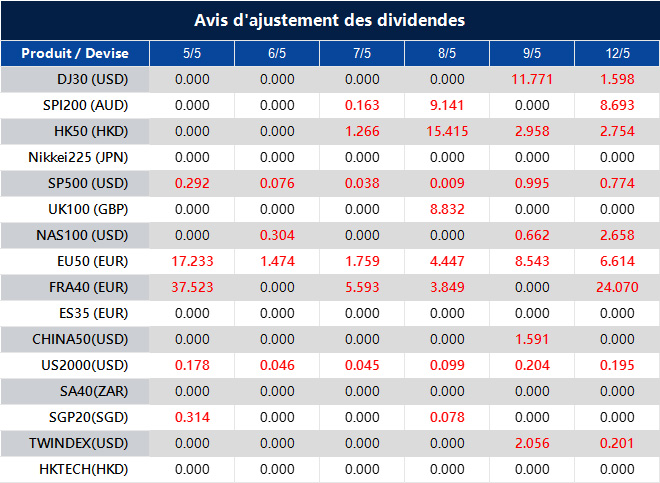
Avis d’ajustement des dividendes – May 05 ,2025

Cher Client,

Veuillez noter que les dividendes des produits suivants seront ajustés en conséquence. Les dividendes des indices seront exécutés séparément via un relevé de solde directement sur votre compte de trading, et le commentaire sera au format suivant : “Div & Nom du produit & Volume net”.

Veuillez consulter le tableau ci-dessous pour plus de détails :

Avis d'ajustement des dividendes

Les données ci-dessus sont fournies à titre de référence uniquement, veuillez consulter le logiciel MT4/MT5 pour des informations précises.

Pour toute information complémentaire, n’hésitez pas à contacter info@vtmarkets.com.

London markets are closed, affecting European flows, while major hubs remain open for limited data releases

London markets are closed today due to May Day, which may lead to reduced trading flows in Europe at the start of the week. Several Asian markets are also observing holidays. However, other European markets remain open as usual.

As for data releases, the schedule is relatively light with Swiss inflation data for April set to be released at 0630 GMT. Following that, the Eurozone Sentix investor confidence data for May will be available at 0830 GMT. There are no significant data releases until US trading begins later in the day.

Impact Of Holidays On Market Activity

That markets in London are shuttered today due to May Day hints at thinner liquidity across much of Europe, especially during the morning session. Since a number of Asian regions are also on holiday, we’ve got a quieter global tone, with slower flows and potentially less volatility in some asset classes. Still, it’s not a complete standstill. Financial centres across the continent outside the UK are keeping normal hours, which means that one can’t quite dismiss the chance of repositioning among institutional desks that remain open.

The economic diary begins with the Swiss CPI numbers. Scheduled early, these will serve as the first inflation reading of the week from the region. Any deviation from expectations could push around current market assumptions about the Swiss National Bank’s next move. If inflation proves hotter than forecast, it might re-anchor some hawkish sentiment in local swaps. Otherwise, softer prints could reinforce the growing view of policy stability through the summer months.

Next up is the Eurozone’s Sentix investor confidence data. Though not the most high-impact figure historically, recent economic wobbles have made sentiment readings a bit more telling. It’s not just about the direction of the number—up or down—but whether it substantiates broader survey-based evidence from businesses and consumers. If investors are indeed becoming less bleak, it would strengthen the story of a mild rebound in the bloc. That has direct consequences for positioning in interest rate futures and FX risk, particularly around carry exposure.

Strategic Considerations For Traders

Outside of this, the economic slate is thin ahead of the US session and by then, volumes will likely pick up as North American accounts take the reins. With the morning relatively quiet, financial institutions may use the lull to reassess short-term holdings or prepare for more impactful drivers later in the week—data from the US jobs market, comments from Fed speakers, and liquidity-relevant central bank bond operations could all be on their radar.

Instruments tied to interest rates or equity volatility might experience sporadic moves in early European dealings, particularly if positioning is unbalanced due to today’s closures. We’ve found in previous similar sessions that initial price action often sees some mean reversion once broader markets resume full participation, usually from midday onwards.

Given today’s shallow event calendar and narrower flow channels, market behaviour may not always align with larger macro stories. This discrepancy can catch traders offside if they overreact to minor impulses. Now isn’t the time to chase weak signals or test marginal levels without conviction. Instead, the more effective strategy is to stay nimble but cautious—reactive rather than aggressive. When volumes return later this week, shapes and structure in the forward curve will matter again.

In sum, Monday offers space for preparation. It gives an opportunity to fine-tune directional exposure, review gamma neutrality, and set hedges that won’t need to be rushed. Those holding optionality may see some time decay today with little realised movement, and that needs factoring in. By Tuesday, when global desks return to full strength, pace and rhythm will come back—and likely, so will price discovery.

Create your live VT Markets account and start trading now.

In the Philippines, gold prices experienced an increase today based on collected market data

Gold Price Trends In The Philippines

Gold prices increased in the Philippines on Monday, with the price standing at 5,807.87 Philippine Pesos per gram, compared to 5,781.28 PHP on Friday. The price per tola rose from PHP 67,431.71 to PHP 67,741.87.

Gold prices in the Philippines are calculated by adjusting international prices to the local currency and measurement units. These prices are updated daily, though local rates might differ slightly.

Gold is highly valued due to its historical role as a store of value and medium of exchange. It is seen as a safe-haven asset and a hedge against inflation and currency depreciation.

Central banks are the largest purchasers of gold, looking to bolster economic strength by diversifying reserves. They acquired 1,136 tonnes of gold, valued at $70 billion, in 2022, marking the highest yearly purchase ever recorded.

Gold typically has an inverse relationship with the US Dollar and US Treasuries, as well as risk assets, meaning its price often changes in response to these. Geopolitical events and shifts in interest rates also affect the price of gold, with the US Dollar’s movements being particularly influential.

Gold As A Safe Haven

For traders who operate in derivatives markets, particularly those tracking precious metals, the recent uptick in gold prices in the Philippines merits close observation. What we’re seeing is a modest but consistent increase in value from Friday to Monday — roughly a 0.46% change per gram. This shift, although seemingly minor in absolute terms, highlights how sensitive gold prices can be when translated into local currency and alternative units such as the tola. A movement like this, though typical in an asset often considered stable, can point to broader undercurrents in market sentiment and currency behaviour.

The prices quoted within the Philippines don’t arise in isolation. They’re based on the international spot price of gold, typically tied to benchmarks such as the London Bullion Market, and then converted into peso terms. Thus, these figures inherently carry the influence of both dollar dynamics and FX volatility. When we consider the minor local refinements — due to tax, logistics, and regional supply factors — it’s useful to remember that the headline numbers might deviate slightly on-the-ground.

Gold has long stood as a financial asset favoured in times of uncertainty. Its utility as a store of purchasing power becomes more pronounced when fiat currencies weaken, inflation persists, or real yields sink. This is precisely why interest among institutional actors — notably central banks — remains strong. The 1,136 tonnes acquired in 2022, valued at around $70 billion, isn’t just a data point. It’s a reflection of broader macroeconomic caution and a reluctance to remain concentrated in paper-based reserves. One should interpret this accumulation as reflective of global unease around currency stability and long-term sovereign balance sheet security.

The metal’s traditional pattern of movement — typically inverse to both the US Dollar and Treasuries — remains intact. When bond yields rise or the greenback appreciates, gold tends to fall out of favour. And yet, in times when risk assets wobble or geopolitical unease heightens, capital tends to seek security, often rotating back into metals. These behaviours don’t always play out in straight lines, but a trader watching volume alongside yield curve adjustments can usually see the shifts forming early.

Rate policy remains the primary trigger for near-term gold volatility. With the Federal Reserve’s decisions under ongoing scrutiny, even slight deviations from expected language can spark rounds of re-pricing across both commodity and currency spaces. Given the tight correlation between US rate outlooks and gold flow behaviour, especially among institutional actors, it’s necessary to monitor Fed-forward guidance and bond auction demand with some diligence.

Expect more near-term activity on hedging contracts, particularly if CPI data or wage growth figures in the United States diverge from recent trendlines. We typically observe that weekly options become more sensitive ahead of such data prints, which suggests short-term positioning could accelerate. Watch closely the front-month implied volatility; any widening there may hint at a pickup in directional bets or even an increase in protective positioning.

Phillips’ findings regarding reserve composition changes should prompt us to review our weighting assumptions in any commodity basket exposure. While bullion continues to move in reaction to economic fundamentals, increased institutional buying and the diversification from traditional currency reserves suggest that elasticity on the demand side can be stronger than in past cycles.

The behaviour seen in late 2022 and through 2023 — especially following offshore banking policy shifts and mid-sized currency devaluations — presents an environment where traders might need shorter reaction windows. Modules tied to real rates and moving average crossovers, for example, are moving faster. This should be considered when constructing or adjusting straddle and strangle strategies, particularly across the quarter-end roll.

Ultimately, price action is being pulled from both sides — real yields on one end and safe-haven flows on the other. The middle ground for price discovery now faces a narrower path, especially in lower-liquidity Asian sessions. This tightrope effect will likely result in increasingly compressed expiry windows or the recalibration of margin requirements from local derivatives brokers, depending on how the next few macro data releases unfold.

Create your live VT Markets account and start trading now.

Market expectations indicate interest rates will likely remain unchanged, despite Trump’s ongoing criticism of Powell

As the FOMC meeting approaches, the Federal Reserve is expected to maintain current interest rates. Despite economic softening, conditions have not compelled a strong policy response, with price pressures, particularly PCE, remaining steady. The prospect of tariffs keeps Federal Reserve assessments cautious. Current market predictions place the likelihood of a rate change at around 2%.

President Trump has publicly expressed his dissatisfaction with the lack of rate cuts, recently tweeting that the Fed should lower rates due to perceived low inflation. While he has indicated no current plans to dismiss Chair Jerome Powell, further comments from Trump criticising Federal Reserve decisions are anticipated if rates remain unchanged. This situation may lead to a repetition of the ongoing public discourse between the two.

Interest Rates Expectations

In plain terms, the Federal Reserve isn’t expected to adjust interest rates anytime soon. Even though the overall economic activity has eased slightly, core inflation – particularly when measured by the preferred Personal Consumption Expenditures (PCE) index – hasn’t retreated enough to warrant a major change in stance. This leaves the central bank with little immediate reason to act.

Also keeping policymakers cautious are uncertainties around global trade. While it might have softened somewhat recently, the mere possibility of fresh tariffs still clouds the outlook. None of this is happening in isolation; it all feeds into a wider discussion about the appropriate pace and direction of monetary policy.

Trump’s vocal approach to central banking policy is certainly not new, though it remains outside the usual boundaries for a head of state. His latest remarks again challenge the Federal Reserve’s reluctance to deliver a cut. Although he has pulled back from any direct threats to remove Powell, the pattern of indirect pressure seems likely to continue, especially if the committee sticks to its current course. From a distance, this might look like just more bluster – but it can shape short-term sentiment in key markets nonetheless.

Market Implications

Now, in practical terms, those of us active in rates derivatives ought to refocus attention, not toward headline drama, but toward what’s actually being priced. The implied probability of a move is barely registering – under 3% depending on rounding – and volatility remains relatively contained. There’s been no spike in skew and no meaningful divergence in rate expectations across the curve. Short-term contracts suggest that a stable hold is not just expected but widely agreed upon. That gives options traders very little reason to pay up unless they see sharp movement elsewhere.

For us, this kind of disconnection between political rhetoric and institutional behaviour provides unusually fertile ground for tactical positioning. It’s clear that the rate path hasn’t adjusted in response to Tweets – not this time. The message from Powell and his committee hasn’t been shaken by jawboning, and the dot plots remain broadly supportive of patience. We’re now looking more at small reallocations along the belly of the curve, not full-blown directional risk.

So, then, it’s not about dramatic changes but measuring which parts are least aligned with policy inertia. If volatility picks up due to unexpected remarks or a sudden change in trade dialogue, the market will move fast – not because a shift is likely, but because pricing has left too small a margin for error. There are mispricings out there, though they’re narrow and transient.

In the coming fortnight, any response needs to be highly selective. It’s not a question of betting on a change, but of aligning positions with a forward guidance strategy that remains largely unchanged. That makes it more about relative value rather than broad curve reshaping. We’re paying very close attention to mid-tenor options and monitoring whether expectations six to nine months out begin to show any foundation weakening. Right now, though, there’s very little indication that the Fed’s core message has changed direction.

And until it does, most of what we’re doing involves leaning very slightly against overconfidence in the hold scenario, while recognising that the broader structure remains pretty tightly managed.

Create your live VT Markets account and start trading now.

In the United Arab Emirates, gold prices have increased, based on recent data analysis

Gold prices in the United Arab Emirates rose on Monday. The price per gram increased to 384.46 AED from 382.67 AED on Friday.

Gold price per tola climbed to 4,484.31 AED from 4,463.35 AED last week. The exchange rate updates the values daily based on market rates.

Geopolitical Influence

Russian President Vladimir Putin spoke about ending the Ukraine conflict. Meanwhile, Israeli Prime Minister Netanyahu vowed responses to Yemen’s Houthi missiles.

US President Donald Trump imposed a 100% tariff on foreign films. This uncertainty boosts safe-haven flows, benefiting gold.

Traders adjusted bets against a US Federal Reserve rate cut. Strong US job data showed 177K jobs added in April.

The US Dollar remains weak following tariff news. This supports the XAU/USD pair, ahead of the upcoming Federal Reserve policy meeting.

Gold often inversely correlates with the US Dollar and Treasuries. Prices rise with geopolitical instability or lower interest rates.

Central banks are major gold buyers, with 1,136 tonnes added in 2022. Countries like China and India are increasing their gold reserves.

Market Positioning

What the article is really unpacking is the number of variables at play, each nudging gold prices in its own way, with some more forcefully than others. The rise in price per gram and per tola in the UAE reflects this. Those changes are not merely local quirks; they’re downstream effects of broader movements. So when gold inched up by nearly two dirhams per gram, it’s not just a footnote—it’s a reaction to actual risk preferences shifting globally.

At the centre of it all are geopolitical tremors: updates from Russia and Israel are pushing risk sentiment into less comfortable territory. President Putin’s remarks on Ukraine weren’t brushed off as rhetoric—they were processed as early signs of tension relief. Conversely, Netanyahu’s remarks to retaliate against missile attacks have added more weight to risk-off sentiment. Together, such moves keep safe-haven demand buoyant. We must weigh these comments not only at face value but in the context of how they influence capital flows and policy expectations.

In the background, policy noise from Washington creates more volatility. The 100% tariff bump on foreign films—though limited in scope—signals broader protectionist leanings. And while the inflationary consequences may be minor directly, the measure contributes to an atmosphere of trade friction that investors don’t usually take lightly.

The market is still digesting the April jobs data. A 177,000 figure, while not stellar, is more than sufficient to keep expectations of rate cuts on pause. Such data—alongside the delayed Fed pivot rhetoric—affects gold indirectly by propping up US yields. Yet, if yields hold steady while the dollar softens, gold finds some space to drift higher without requiring fresh triggers.

The dollar’s recent weakness, particularly post-tariff news, has lent further support to gold denominated in USD. That’s foundational maths—when the greenback loses value, it takes more of it to buy the same ounce of metal. The XAU/USD pair continues to reflect this seesaw relationship.

Rates and geopolitics aside, there is a structural undercurrent that shouldn’t go ignored: central bank buying. It’s not anecdotal when 1,136 tonnes are bought in a 12-month window. We note that China and India remain consistent as buyers, maintaining upward pressure on demand even when short-term signals are mixed. That floor of structural demand can temper volatility, especially during episodes of profit-taking.

All this means that derivative positioning has to remain nimble. We would tilt towards caution before any firm US central bank signals arrive, but continue to look for intraday moves that echo dollar sentiment and front-end yield shifts. Volatility may not spike immediately, but the ingredients for sharp intraday shifts are there.

Create your live VT Markets account and start trading now.

Recent developments included a drop in oil prices and an extraordinary rise in the Taiwan dollar

Barclays has reduced its Brent crude price outlook, citing unexpected production hikes by OPEC+. OPEC+ has agreed to increase oil output by 411,000 barrels per day in June, continuing May’s trend of supply acceleration.

The Taiwan dollar experienced a remarkable move described as a 19-standard deviation event by MUFG. This surge has sparked discussions about currency revaluation in some Asian countries, potentially as a response to tariff negotiations with the United States.

Chinese Export Predictions

Goldman Sachs predicts a decline in Chinese exports extending through 2026. The US dollar is losing ground amidst holiday-thinned trade in Asia. Meanwhile, US President Trump announced plans for a 100% tariff on foreign-made movies and confirmed the Federal Reserve Chair will remain until his term ends in 2026.

In regional economic activity, Australia’s job advertisements rose by 0.5% in April, while its inflation gauge showed a month-on-month increase of 0.6%. The overarching market narrative is being challenged by some analysts, even in light of OPEC+’s production decisions impacting oil prices. Gold prices saw some initial gains during Asian trading before retracting later.

Barclays’ decision to cut its Brent crude forecast came following fresh output increases from OPEC+. With an additional 411,000 barrels per day flooding the market in June—on top of May’s ramp-up—the expected supply tightness has eased. The usual assumption here is straightforward: more supply presses down on prices. In theory, this should translate into sustained pressure on front-month crude contracts.

For shorter-dated futures, this pressure could manifest through weaker roll premiums and a flatter forward curve. What’s more, increased production undermines any bullish bets that depended solely on tight market dynamics in the coming quarter. It’s not often that we witness a policy commitment from OPEC+ that so directly contradicts earlier production restraint narratives, and that dissonance is worth keeping front of mind.

Taiwan Dollar’s Remarkable Move

Now shifting attention to foreign exchange, the Taiwan dollar’s outsized move—described as a 19-standard deviation event by MUFG—has rightly drawn widespread attention. This scale of deviation doesn’t occur in isolation. Typically, such a sharp strengthening reflects both positioning stress and political undertones. There’s growing chatter that certain Asian policymakers might opt for targeted currency strengthening in response to international trade pressure, especially from Washington. This could emerge through less frequent intervention or even, more pointedly, a soft shift towards appreciation bias.

If that becomes a broader pattern, then regional volatilities may break further from historical norms. The debate over whether this is a one-off repricing or the start of a structural revaluation cycle is worth following closely. There’s also a tactical angle: short gamma positions are vulnerable in such an environment.

Meanwhile, according to Goldman Sachs, Chinese exports aren’t expected to recover any time soon. A downbeat view stretching into 2026 implies that external demand—especially from the West—is not sturdy enough to offset ongoing structural issues at home. It’s also a reflection of how global manufacturing orders are shifting. These projections aren’t just theoretical—they map directly into weaker trade surpluses, less support for the renminbi, and spillovers across Asian supply chains.

At the same time, the dollar is drifting lower, though volumes remain thin amid restricted activity in Asian markets. With no strong directional conviction appearing in the dollar, options premia might begin to compress. That said, pockets of the curve remain vulnerable to supply-demand imbalances in swaps and repo channels. Especially if macro releases or central bank guidance jolt expectations.

They’ve also added further complexity in Washington. An announcement of a 100% tariff on films shot outside the US is a striking turn—in both cultural and economic messaging. It’s not just a domestic signal. Once tariffs creep into media and entertainment, the risk of further retaliatory measures broadens. That affects sentiment and policy expectations in indirect but powerful ways. This move underscores a protectionist tilt that may eventually stir up volatility, even in markets one wouldn’t normally associate with traditional trade policy headlines.

Regarding the central bank, confirmation that continuity will be preserved at the Fed until the end of 2026 counters recent speculation. It removes one variable from the near-term monetary policy outlook, which—despite calm at the surface—remains particularly reactive to inflation shifts and labour market signals.

Looking to Australia, the latest job adverts rose by 0.5%—a modest but steady signal of labour demand. More striking, though, was the 0.6% month-on-month rise in the inflation gauge. It’s not extreme on its own, but when paired, the two figures suggest domestic demand remains firm, complicating the notion that rate cuts are imminent. Money markets could begin reassessing the pacing of future central bank actions, particularly if incoming CPI releases echo this trend.

Earlier in the session, gold found initial buyers before retracing. The move looked technical, possibly reflecting dollar positioning rather than fresh conviction in the metal itself. When we see such behaviour—intraday rallies met by swift unwinding—it often indicates that sentiment lacks cohesion and that cross-asset hedging is in play.

Taken together, these developments shape a more defined backdrop for derivatives: price discovery remains driven by abrupt data hits, policy tweaks, and multi-asset correlations that are shifting quicker than seasonal norms would suggest. We’re preparing for wider tails and potentially more volatility in instruments typically treated as stable.

Create your live VT Markets account and start trading now.

Back To Top
server

Bonjour 👋

Comment puis-je vous aider ?

Discutez immédiatement avec notre équipe

Chat en direct

Démarrez une conversation en direct via...

  • Telegram
    hold En attente
  • Bientôt disponible...

Bonjour 👋

Comment puis-je vous aider ?

Telegram

Scannez le code QR avec votre smartphone pour démarrer un chat avec nous, ou cliquez ici.

Vous n’avez pas l’application ou la version de bureau de Telegram installée ? Utilisez plutôt Telegram Web .

QR code